About

Work-in-progress dataset compiled from public sources (see references). The life of Jesus is dated as the sources date it: the Gospels are cited as the texts that narrate it, the ancient historians and modern scholars for the dates they establish, and where they disagree — the year of the birth, the year and day of the crucifixion — the disagreement is recorded rather than resolved. Miracles and the Resurrection are recorded as what the Gospels narrate and the Church believes; the site neither asserts nor denies them. The relics are recorded object by object: each entry states one authority's act about one named object and cites the document. Expositions, feasts, indulgences, jubilees and papal visits are acts of cult, not rulings on authenticity, and no Church act declaring any of these objects authentic was located. Laboratory results belong to their laboratories; published critiques are recorded as critiques. Years before the common era are written BCE. Dates resting on a single source, or on a source that could not be read in full, are flagged with a ? mark. Corrections against primary sources are welcome.

Shroud of Turin
Turin Cathedral, Italy, sealed and normally not visible. Owned by the Holy See since 1983; kept by the Archbishop of Turin as Pontifical Custodian. Radiocarbon-dated in 1988 to 1260–1390, a result contested by later critiques; the custodian says the tradition "cannot yet be said to be definitively proven".[38] [39] [48]
Sudarium of Oviedo
Cámara Santa of Oviedo Cathedral, Spain. First attested in 1075. Radiocarbon results are reported for 1990–1992 and 2007, but no primary publication of them was located.[57] [58]
Veil of Veronica and the Volto Santo
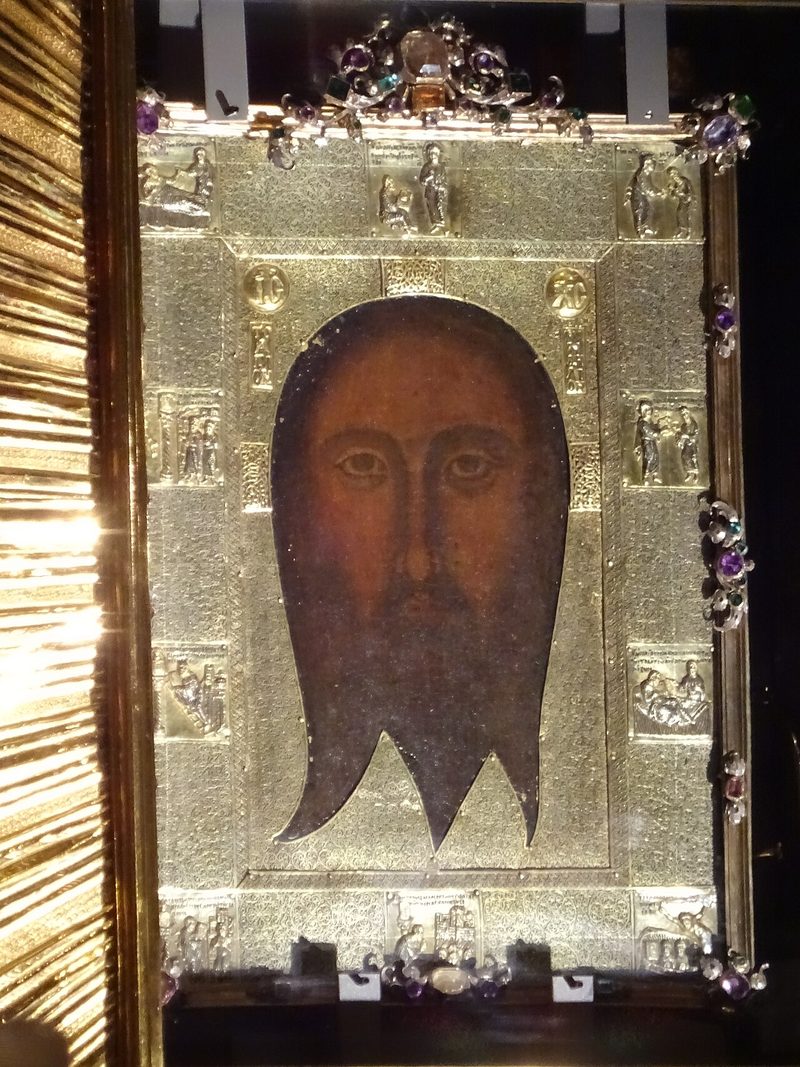
St Peter's Basilica, Vatican City, exposed each fifth Sunday of Lent; and the Capuchin shrine of Manoppello, Italy, which claims the original Veronica for itself. The two claims conflict.[60] [62]
Holy Tunic
Trier Cathedral, Germany (first attested 1196; not visible, its authenticity "cannot be answered with certainty", per the cathedral); and the Basilica of Saint-Denys, Argenteuil, France (first attested 1156; radiocarbon-dated to 530–650, per the parish, which last exposed it in April–May 2025).[65] [66] [67]
Holy Blood
Basilica of the Holy Blood, Bruges, Belgium, venerated daily; the procession is on UNESCO's intangible-heritage list. The basilica records that historians strongly doubt the traditional arrival in 1150.[69] [70]
True Cross
Fragments at Santa Croce in Gerusalemme (Rome; relic chapel closed from April 2026), St Peter's, Notre-Dame de Paris, the Holy Sepulchre in Jerusalem and the Mother See of Etchmiadzin, among many others. First attested c. 348–350; no scientific dating of the wood was located.[82] [77] [97] [71]
Titulus Crucis
Santa Croce in Gerusalemme, Rome. Found in 1492; radiocarbon-dated in 2002 to AD 980–1146.[82] [83]
Holy Nails
Santa Croce (Rome), Notre-Dame de Paris, the Iron Crown of Monza and the pin of Vienna's Holy Lance, among some thirty venerated nails; the Catholic Encyclopedia holds that "very little reliance" can be placed on most.[82] [86] [85]
Crown of Thorns
Notre-Dame de Paris, since its return on 13 December 2024; shown every Friday and venerated on the first Friday of the month. In Paris since 1239.[87]
Holy Lances
At least four objects: St Peter's, Vatican City (received 1492); the Imperial Treasury, Vienna (an 8th-century lance, per its museum); Etchmiadzin, Armenia; and Kraków. Which, if any, is the lance "found" at Antioch in 1098 is disputed.[93] [94] [97] [92]
Scala Sancta
Pontifical Sanctuary of the Scala Santa, Rome, kept by the Passionists; venerated as the stairs of Pilate's palace by a tradition the sanctuary reports as tradition.[98]
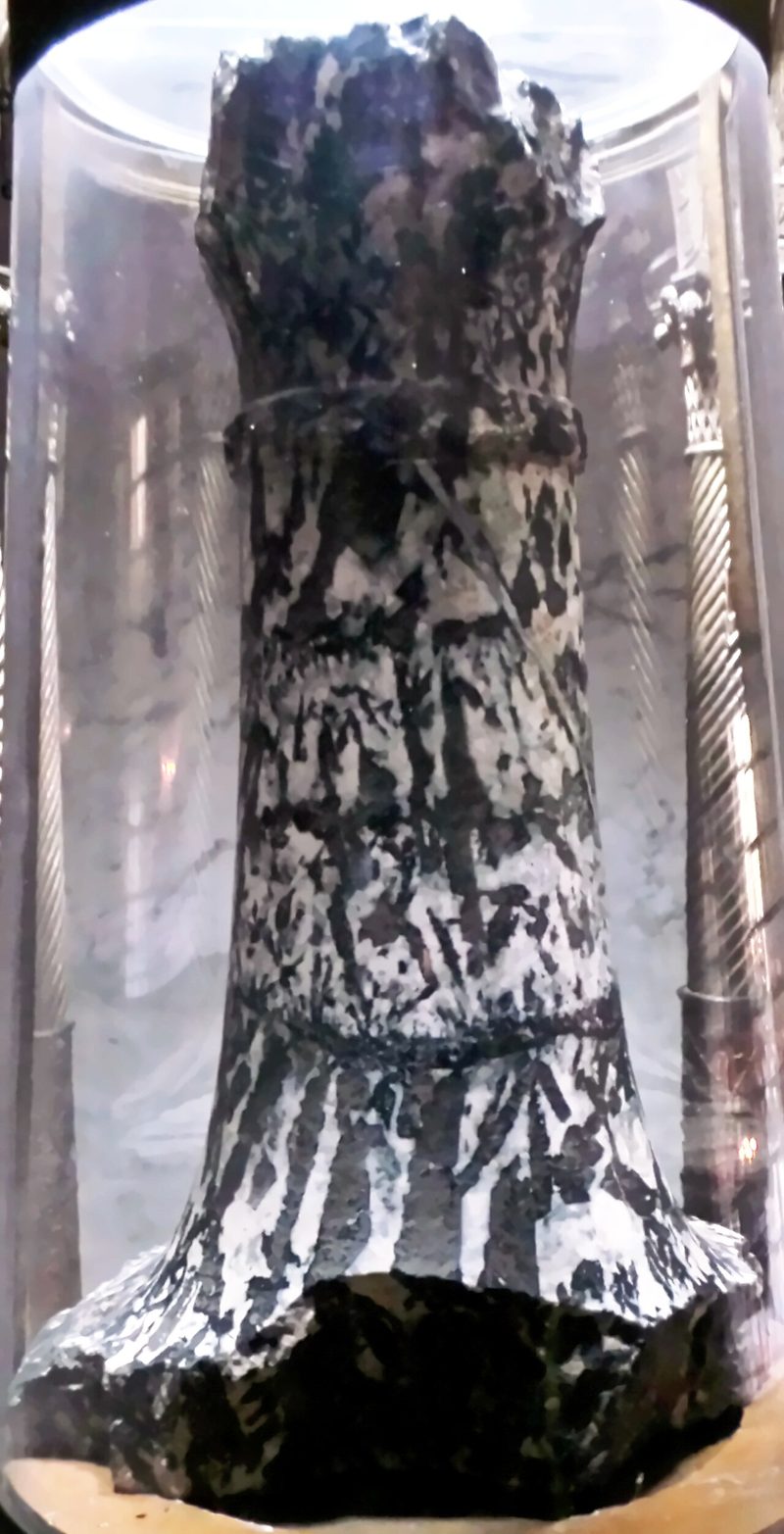
Columns of the Flagellation
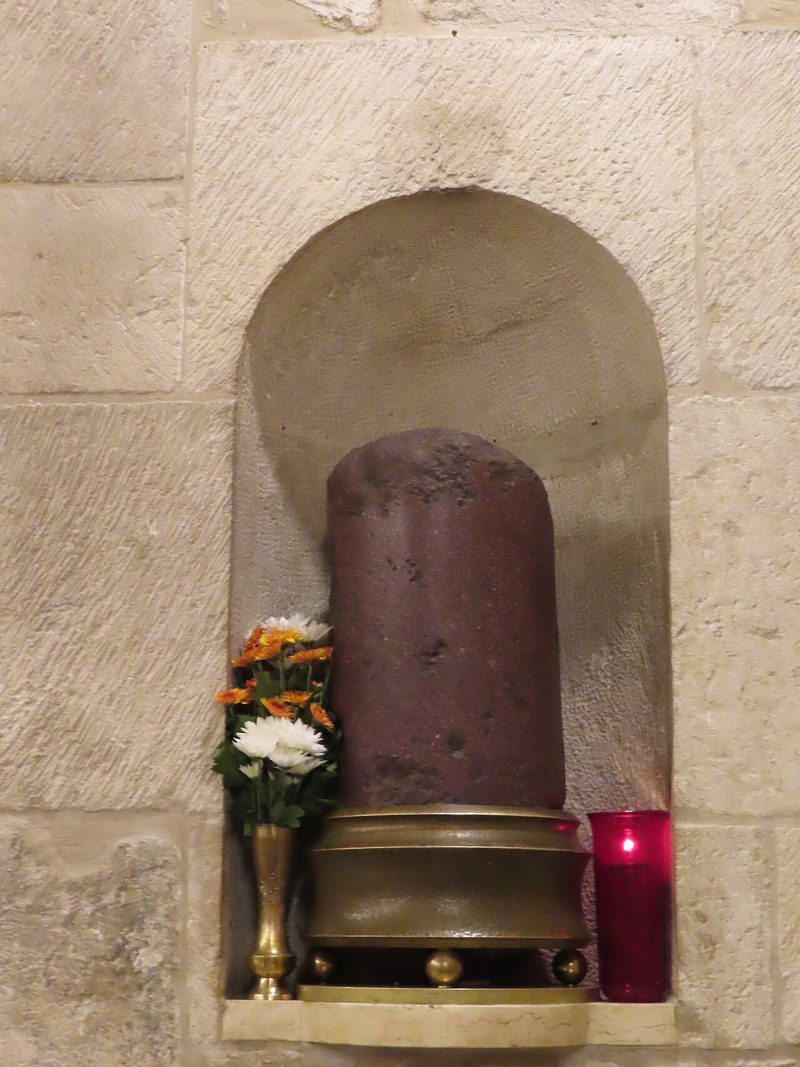
Two rival claims: a black-and-white column at Santa Prassede, Rome, and a red porphyry fragment in the Franciscan chapel of the Holy Sepulchre, Jerusalem. Different stones. The Custody's own pages date the Jerusalem fragment's arrival at the Holy Sepulchre differently: 1553 and the 14th century.[102] [77] [103]
Holy Chalice
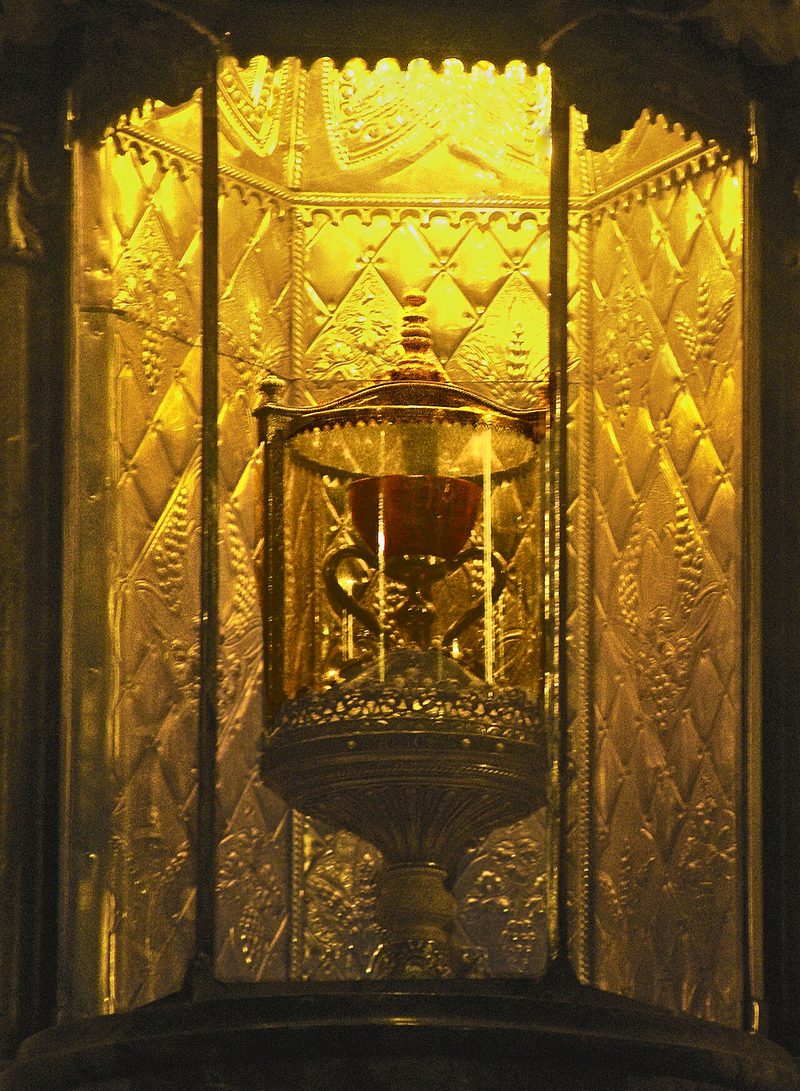
Valencia Cathedral, Spain: an agate cup the cathedral dates to the 1st century BC, with medieval mounts, venerated by tradition as the cup of the Last Supper. Since 2015 the Apostolic Penitentiary has made it a perpetual jubilee site — an act of cult. Genoa's Sacro Catino, once called the Grail, was shown in 1806 to be glass.[104] [105] [106]
What the Church has decided about authenticity
No Church act declaring any of these objects authentic was located. John Paul II said in 1998 that the Church "has no specific competence to pronounce" on the Shroud; the Holy See's 2017 instruction on relics concerns relics of the Blessed and the Saints. Expositions, feasts, indulgences and papal visits are acts of cult, recorded as such.[46] [109]

Chronology

Key events in chronological order. A ? flag marks dates not yet verified against a primary source.

2 decades with no recorded events (70–89)18 decades with no recorded events (140–319)3 decades with no recorded events (350–379)12 decades with no recorded events (400–519)8 decades with no recorded events (530–609)43 decades with no recorded events (640–1069)4 decades with no recorded events (1110–1149)2 decades with no recorded events (1160–1179)3 decades with no recorded events (1200–1229)4 decades with no recorded events (1250–1289)5 decades with no recorded events (1300–1349)2 decades with no recorded events (1360–1379)9 decades with no recorded events (1400–1489)3 decades with no recorded events (1500–1529)2 decades with no recorded events (1550–1569)21 decades with no recorded events (1590–1799)4 decades with no recorded events (1810–1849)6 decades with no recorded events (1900–1959) 6 BCE649313032638152561410751156123912911389149215761806189819612026
  1. 6 BCE ?

    The life, as the sources date itBethlehem

    The birth of Jesus, as Matthew dates it: "in the days of King Herod"

    Matthew narrates that Jesus "was born in Bethlehem of Judea, in the days of King Herod", and that the family fled to Egypt and returned only "when Herod had died". Scholars who follow Matthew's anchor place the birth a few years before 4 BCE.[3] [17] [18]

    A range, not a date. Maas (Catholic Encyclopedia, 1910) derives 7–5 BCE from Herod's death and Matthew 2:16; the encyclopedia's "General Chronology" reports that "many" place the birth in 4 BCE. Both put it before Herod's death, which Luke's census (6 CE) does not.

    Competing dates 7 BCE–4 BCE

    • 7 BCE–5 BCE Maas (Catholic Encyclopedia, 1910), reckoning from Herod's death and Matthew 2:16[17]
    • 4 BCE The date "many" hold, as the Catholic Encyclopedia's "General Chronology" reports[18]
  2. 4 BCE

    The life, as the sources date itJudea

    Death of Herod the Great

    Josephus places Herod's death shortly after an eclipse of the moon; the Catholic bishops' Bible notes that he "reigned from 37 to 4 B.C." Matthew's birth narrative is set in his reign, so the birth of Jesus falls before 4 BCE by Matthew's account.[11] [20] [3]

    The majority date, from Josephus: the death follows a lunar eclipse that Whiston and the Catholic Encyclopedia identify as that of 12–13 March 4 BCE. A minority argues for 1 BCE (Filmer, 1966; Steinmann, 2009); those studies were not read for this dataset.

  3. 6

    The life, as the sources date itBethlehem

    Luke's census "when Quirinius was governor of Syria"

    Luke narrates that Joseph and Mary went to Bethlehem to be enrolled in "the first enrollment, when Quirinius was governor of Syria". Quirinius became legate of Syria in 6–7 CE, about a decade after Herod's death. The Catholic bishops' own Bible notes that there are "notorious historical problems" with this dating and that "the various attempts to resolve the difficulties have proved unsuccessful".[1] [11]

    The census date is well attested (6–7 CE); that Jesus was born at it is Luke's narrative, which cannot be reconciled with Matthew's Herod-era birth.

  4. 14

    The life, as the sources date itRome, Italy

    Tiberius succeeds Augustus

    Tiberius becomes emperor. Luke's "fifteenth year of Tiberius", which dates the start of John the Baptist's preaching, is counted from his reign.[2] [11]

    19 August 14, per Whiston's note; the year is secure.

  5. 18 ?

    The life, as the sources date itJerusalem

    Caiaphas becomes high priest

    Joseph Caiaphas is appointed high priest by the Roman prefect Valerius Gratus; his father-in-law Annas had held the office in 6–15. Both appear in the Gospels' account of the Passion.[22] [2]

    "About A.D. 18" (Catholic Encyclopedia); the bishops' Bible note gives Caiaphas's high priesthood as 18–36.

  6. 26

    The life, as the sources date itCaesarea Maritima, Israel

    Pontius Pilate becomes prefect of Judea

    Pilate succeeds Valerius Gratus; the bishops' Bible note calls him "prefect of Judea from A.D. 26 to 36". An inscription found at Caesarea in 1961 gives his title as prefect; Tacitus and later writers call him procurator.[2] [21] [11]

  7. 28 ?

    The life, as the sources date itJordan River

    "The fifteenth year of Tiberius": John the Baptist begins to preach

    Luke dates the start of John's preaching by a full set of anchors: the fifteenth year of Tiberius, when Pilate governed Judea and Herod Antipas Galilee, "during the high priesthood of Annas and Caiaphas".[2] [17]

    The bishops' Bible note puts the fifteenth year of Tiberius "between A.D. 27 and 29"; counted from an earlier co-regency it falls c. 26; Maas gives 25/26 or 29.

    Competing dates 25–29

    • 25–26 Maas (Catholic Encyclopedia), one of his two reckonings[17]
    • 27–29 The U.S. bishops' Bible note on Luke 3:1[2]
    • 29 Maas, his other reckoning[17]
  8. 28 ?

    The life, as the sources date itJordan River

    The baptism of Jesus and the start of his ministry

    The Gospels narrate that Jesus was baptized by John and began to preach; Luke says he was "about thirty years of age". The Synoptic Gospels can be read as describing a single year of ministry; John mentions three Passovers.[2] [17] [29]

    A range, c. 27–29 on Luke's synchronism; Maas, reckoning from a 7–5 BCE birth, puts the public life earlier.

  9. 30 ?

    The life, as the sources date itJerusalem

    The crucifixion of Jesus under Pontius Pilate

    The Gospels narrate that Jesus was condemned by Pilate and crucified at "the Place of the Skull, in Hebrew, Golgotha". Tacitus writes that "Christus … had undergone the death penalty in the reign of Tiberius, by sentence of the procurator Pontius Pilatus" — the Roman historian's independent witness to the execution.[10] [8] [12] [29] [30] [17]

    Two dates remain in play: Friday 7 April 30 and Friday 3 April 33 (Julian). Humphreys and Waddington favour 33 but write that "the date 7 April AD 30 is also strongly supported" and that the question cannot be decided conclusively; a patristic tradition cited by Maas gives 29. The Synoptic Gospels place the death on the day after the Passover meal, John on the day of preparation; Mark says the crucifixion was at the third hour, John that the sentence came "about noon".

    Competing dates 29–33

    • 29 A patristic tradition, as cited by Maas (Catholic Encyclopedia)[17]
    • 30 Friday 7 April 30: "also strongly supported", in Humphreys and Waddington's words[29]
    • 33 Friday 3 April 33: the date Humphreys and Waddington favour[29] [30]
  10. 30 ?

    The life, as the sources date itJerusalem

    The empty tomb and the Resurrection, as proclaimed

    The Gospels narrate that women found the tomb open "very early … on the first day of the week"; Paul hands on an earlier formula, that Christ "was raised on the third day" and "appeared to Cephas, then to the Twelve". Christians profess the Resurrection; historians treat the proclamation as the earliest disciples' claim. This site records both, and adjudicates neither.[9] [6]

    "The first day of the week" after the crucifixion — so 9 April 30 or 5 April 33, depending on the crucifixion year.

  11. 30 ?

    The life, as the sources date itJerusalem

    The Ascension, as narrated

    Acts narrates appearances "during forty days" and that on the Mount of Olives "he was lifted up, and a cloud took him from their sight".[4]

    Acts gives forty days after Easter; Luke 24 appears to place the ascension at Bethany on Easter day itself.

  12. 35 ?

    The life, as the sources date itDamascus, Syria

    The conversion of Paul

    Acts narrates that on the road to Damascus a light flashed and a voice said, "Saul, Saul, why are you persecuting me?"[5] [25]

    A reckoning, not a record: Prat (Catholic Encyclopedia) holds it "not prior to 34" and proposes 35; the absolute date depends on the crucifixion year.

  13. 36

    The life, as the sources date itJerusalem

    Pilate is recalled; Caiaphas is removed

    Josephus writes that Pilate, "when he had tarried ten years in Judea, made haste to Rome", arriving after Tiberius had died; the Syrian legate Vitellius removes Caiaphas from the high priesthood.[11] [21] [22] [31]

  14. 49 ?

    Outside witnesses and memory-sitesRome, Italy

    Suetonius: Claudius expels Jews "at the instigation of Chrestus"

    Suetonius writes that "since the Jews constantly made disturbances at the instigation of Chrestus", Claudius expelled them from Rome — read by many as an early, garbled reference to Christ, by others as a different man.[13]

    Suetonius gives no year; 49 rests on the 5th-century Orosius, not read here. Whether "Chrestus" means Jesus is disputed.

  15. 62 ?

    Outside witnesses and memory-sitesJerusalem

    Josephus: James, "the brother of Jesus, who was called Christ", is stoned

    Josephus narrates that the high priest Ananus convened the Sanhedrin and had James, "the brother of Jesus, who was called Christ", stoned.[11]

    The year is an inference from the interval between the procurators Festus and Albinus; Josephus gives no number.

  16. 64

    Outside witnesses and memory-sitesRome, Italy

    Tacitus: Nero blames the Christians for the fire of Rome

    Tacitus records that Nero punished "Christians" for the Great Fire, and explains the name: "Christus, the founder of the name, had undergone the death penalty in the reign of Tiberius, by sentence of the procurator Pontius Pilatus".[12]

    Tacitus dates the fire by the consulship of Laecanius and Licinius, which is 64.

  17. 2 decades with no recorded events (70–89)
  18. 93 ?

    Outside witnesses and memory-sitesRome, Italy

    Josephus's Antiquities and the Testimonium Flavianum

    The Antiquities contain a paragraph calling Jesus "a wise man, if it be lawful to call him a man" and saying "He was [the] Christ". Its authenticity has long been disputed; even the Catholic Encyclopedia of 1910 wrote that "the difficulty has not been definitively settled. The passage seems to suffer from repeated interpolations."[11] [24]

    93/94, the thirteenth year of Domitian — a date not confirmed in a source read here. The passage's authenticity is disputed.

  19. 111 ?

    Outside witnesses and memory-sitesBithynia, Turkey

    Pliny the Younger writes to Trajan about the Christians

    Governing Bithynia, Pliny reports that Christians "met on a stated day before it was light, and addressed a form of prayer to Christ, as to a divinity" — a Roman official's description of early Christian worship.[14]

    Pliny's governorship of Bithynia is usually dated c. 111–113; no source read here gives the year.

  20. 130 ?

    Outside witnesses and memory-sitesJerusalem

    A temple is built over the site later venerated as the tomb

    Eusebius writes that the tomb had been buried and covered with "a gloomy shrine of lifeless idols to the impure spirit whom they call Venus" — the site Constantine later cleared.[15] [36]

    Eusebius gives no year; the attribution to Hadrian's foundation of Aelia Capitolina, c. 130, is a tertiary source's.

  21. 18 decades with no recorded events (140–319)
  22. 326

    Outside witnesses and memory-sitesJerusalem

    Constantine clears the site and the tomb is found

    Eusebius narrates that when the ground was cleared, "contrary to all expectation, the venerable and hollowed monument of our Saviour's resurrection was discovered", and reproduces Constantine's letter ordering a church. The identification is Eusebius's and the Church's; the Catholic Encyclopedia notes that knowledge of the place was held to have been handed down by oral tradition. Eusebius does not mention the Cross here.[15] [28]

    c. 326, per the Catholic Encyclopedia; Eusebius gives no year.

  23. 327 ?

    Outside witnesses and memory-sitesBethlehem / Jerusalem

    Helena founds churches at Bethlehem and on the Mount of Olives

    Eusebius narrates that Constantine's mother Helena "dedicated two churches", one at the grotto of the Nativity and one "on the mount of his ascension".[15] [53] [33]

    The Catholic Encyclopedia dates the journey after 324; the Biblical Archaeology Society gives 327; Eusebius gives no year.

  24. 335

    Outside witnesses and memory-sitesJerusalem

    The church of the Holy Sepulchre is dedicated

    Bishops gather at Jerusalem for the dedication of Constantine's church at the tomb, per Eusebius.[16] [36] [28]

    13 September 335, per the tertiary source; the Catholic Encyclopedia gives 336. Eusebius places it in Constantine's thirtieth regnal year (July 335 – July 336).

    Competing dates 335–336

    • 335 13 September 335, per the tertiary source[36]
    • 336 The Catholic Encyclopedia[28]
  25. 339 ?

    Outside witnesses and memory-sitesBethlehem

    The Church of the Nativity is consecrated

    The basilica over the grotto venerated as the birthplace is consecrated, per the Biblical Archaeology Society, which adds that the church standing today is Justinian's 6th-century rebuilding.[33]

    31 May 339, per one popular-scholarly source; no institutional page confirming it was read.

  26. 348 ?

    The objects venerated as relicsJerusalem

    Cyril of Jerusalem: the wood of the Cross is already distributed

    In his Catechetical Lectures, Bishop Cyril of Jerusalem says that "the whole world has since been filled with pieces of the wood of the Cross", taken from Jerusalem by the faithful — the earliest attestation of Cross relics this project located. Cyril does not name Helena.[71] [72]

    The Catechetical Lectures are dated c. 348–350.

  27. 3 decades with no recorded events (350–379)
  28. 381 ?

    The objects venerated as relicsJerusalem

    Egeria sees the wood and the title venerated on Good Friday

    The pilgrim Egeria describes a silver-gilt casket brought out at Golgotha on Good Friday, from which "both the wood of the Cross and the title" are placed on a table and guarded by deacons, because someone had once bitten off a piece.[73]

    Egeria's pilgrimage is dated c. 381–384.

  29. 395

    The objects venerated as relicsMilan, Italy

    Ambrose credits Helena with finding the Cross

    In his funeral oration for Theodosius, Ambrose of Milan narrates that Helena found three crosses and identified Christ's by its title, and that she found the nails — the first account this project located that connects Helena with the finding. Eusebius, writing earlier about her journey, does not; later writers such as Rufinus say the Cross was recognised by a miracle, not by the title.[74] [75] [73]

    Delivered on 25 February 395, per the Judaism and Rome commentary.

  30. 12 decades with no recorded events (400–519)
  31. 525 ?

    Outside witnesses and memory-sitesRome, Italy

    Dionysius Exiguus numbers the years from the Incarnation

    Preparing an Easter table, the monk Dionysius Exiguus counts years "from the Incarnation" rather than from the persecuting emperor Diocletian — the origin of the Anno Domini era. By Matthew's account, which puts the birth before Herod's death in 4 BCE, the era's own epoch is several years late.[19] [18] [37]

    525 per the tertiary source; "about the year 527" per the Catholic Encyclopedia.

    Competing dates 525–527

    • 525 The tertiary source[37]
    • 527 "About the year 527", per the Catholic Encyclopedia's "General Chronology"[18]
  32. 8 decades with no recorded events (530–609)
  33. 614 ?

    The objects venerated as relicsJerusalem

    The Persians take the relic of the Cross from Jerusalem

    Persian forces capture Jerusalem and carry off the relic of the Cross, per the Custody of the Holy Land and the Catholic Encyclopedia.[77] [76] [92]

    The Custody of the Holy Land and the Catholic Encyclopedia's "Jerusalem" give 614; the same encyclopedia's "Holy Lance" gives 615.

    Competing dates 614–615

    • 614 The Custody of the Holy Land, and the Catholic Encyclopedia's "Jerusalem"[77] [76]
    • 615 The Catholic Encyclopedia's "Holy Lance"[92]
  34. 630 ?

    The objects venerated as relicsJerusalem

    Heraclius restores the Cross to Jerusalem

    The Byzantine emperor Heraclius brings the relic back to Jerusalem. The Catholic Encyclopedia links the feast of the Exaltation of the Cross (14 September) to his return — a feast, an act of cult.[77] [76]

    The Custody of the Holy Land gives 630; the Catholic Encyclopedia gives 629.

    Competing dates 629–630

    • 629 The Catholic Encyclopedia[76]
    • 630 The Custody of the Holy Land[77]
  35. 43 decades with no recorded events (640–1069)
  36. 10751075-03-13 ?

    The objects venerated as relicsOviedo, Spain

    The Arca Santa of Oviedo is opened: the Sudarium enters the record

    At the solemn opening of the Arca Santa before King Alfonso VI, the relics listed include "de sudario Domini", per the cathedral — the first unambiguous attestation of the cloth now called the Sudarium of Oviedo. The cathedral's account of the ark's journey from Jerusalem in 614 is its tradition.[57]

    13 March 1075 per Oviedo Cathedral; secondary accounts give 14 March. The record of the opening itself was not read.

  37. 1098 ?

    The objects venerated as relicsAntioch (Antakya), Turkey

    A lance is "found" at Antioch

    During the First Crusade, the Provençal pilgrim Peter Bartholomew reports visions of the apostle Andrew and leads a dig that produces a lance, per the chronicler Raymond d'Aguiliers. The Catholic Encyclopedia calls it a "discovery under very questionable circumstances"; which, if any, of the surviving lances it was is disputed.[96] [92]

    June 1098, during the siege of Antioch; the day was not established.

  38. 1101

    The objects venerated as relicsGenoa, Italy

    The Sacro Catino reaches Genoa

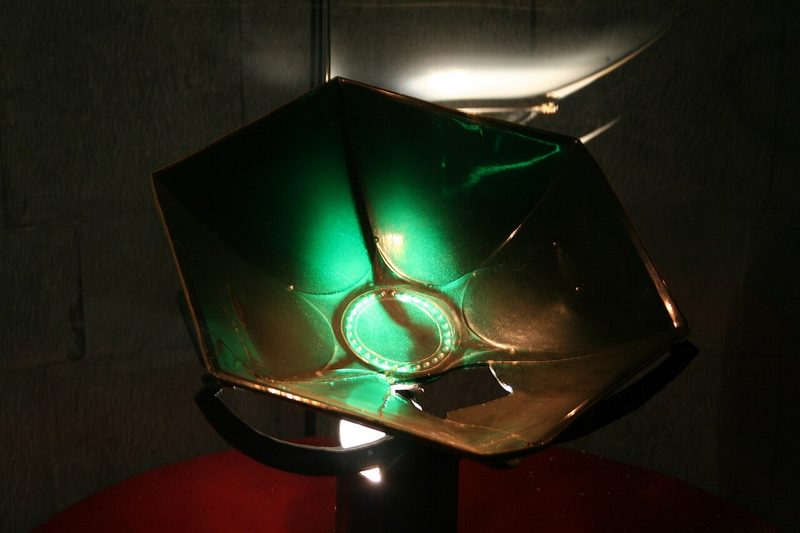
    Guglielmo Embriaco brings to Genoa a green hexagonal dish long held to be emerald and later called the Holy Grail, per the Italian Ministry of Culture. In 1806 it was established to be glass.[106]

  39. 4 decades with no recorded events (1110–1149)
  40. 1156

    The objects venerated as relicsArgenteuil, France

    The Argenteuil tunic is first attested

    A charter records an exposition of the tunic at Argenteuil organised by the Archbishop of Rouen in the presence of Louis VII — the first attestation, per the custodian parish, whose tradition dates the tunic's arrival to Charlemagne's time.[66]

  41. 2 decades with no recorded events (1160–1179)
  42. 11871187-07-04

    The objects venerated as relicsHorns of Hattin, Israel

    The crusaders' relic of the Cross is lost at Hattin

    At the battle of Hattin the crusader army carries its relic of the Cross and loses it: "The Holy Cross also was lost," one contemporary account records; another reports a Templar's claim to have buried it, and a search that found nothing.[78]

  43. 11961196-05-01

    The objects venerated as relicsTrier, Germany

    The Holy Tunic of Trier is first attested

    Archbishop Johann I encloses the tunic in the new high altar of Trier Cathedral, per the Gesta Treverorum as the diocese reports it. The diocese itself describes the story of Helena sending the tunic to Trier as a legend: "a historical event was invented to explain a state of affairs".[63] [64]

  44. 3 decades with no recorded events (1200–1229)
  45. 12391239-08-19

    The objects venerated as relicsParis, France

    Louis IX brings the Crown of Thorns to Paris

    Having redeemed the Crown from the Venetian bankers to whom the Latin emperors of Constantinople had pledged it, Louis IX receives it at Villeneuve-l'Archevêque on 10 August and carries it barefoot into Paris on 19 August, per the Diocese of Paris.[87]

  46. 12481248-04-26

    The objects venerated as relicsParis, France

    The Sainte-Chapelle is consecrated to house the Crown

    The royal chapel Louis IX built for the Crown and his other Passion relics is consecrated. The Crown stays there until the Revolution; the Sainte-Chapelle does not hold it today.[89] [88] [87]

  47. 4 decades with no recorded events (1250–1289)
  48. 1291

    The objects venerated as relicsBruges, Belgium

    The Holy Blood procession is first mentioned

    A by-law of the Bruges porters' guild contains the oldest mention of the procession, per the Basilica of the Holy Blood — which also records that most historians strongly doubt the story of the relic's arrival in 1150 and trace the oldest reliable sources to the 13th century.[69]

  49. 5 decades with no recorded events (1300–1349)
  50. 1353 ?

    The objects venerated as relicsLirey, France

    The Shroud appears at Lirey

    The knight Geoffroi de Charny founds a collegiate church at Lirey in which a cloth bearing the double image of a man is shown for veneration — the first unambiguous appearance of the object now kept in Turin.[55] [54]

    The Catholic Encyclopedia's "Troyes" dates the founding of the Lirey church to 20 June 1353; its "Holy Shroud" says "we first hear of it about the year 1360". The documentary start of the cloth is dated c. 1353–1360.

    Competing dates 1353–1360

    • 1353 The founding of the Lirey church, 20 June 1353, in the Catholic Encyclopedia's "Troyes"[55]
    • 1360 "We first hear of it about the year 1360", in its "Holy Shroud"[54]
  51. 2 decades with no recorded events (1360–1379)
  52. 1389 ?

    The objects venerated as relicsTroyes, France

    Bishop Pierre d'Arcis: the Lirey cloth is "cunningly painted"

    In a memorandum to the Avignon pope Clement VII, the Bishop of Troyes writes that an earlier inquiry by his predecessor had found the cloth "cunningly painted, the truth being attested by the artist who had painted it". The memorandum is his account; defenders of the Shroud dispute its status.[56] [54]

    c. 1389. The memorandum survives as an unsigned, undated draft; whether it was sent is disputed.

  53. 13901390-01-06 ?

    The objects venerated as relicsAvignon, France

    Clement VII rules on the Lirey expositions — read two ways

    The Avignon pope issues bulls on the Lirey cloth. The Catholic Encyclopedia's "Troyes" says they "approved the exposition as lawful"; its "Holy Shroud" says the pope required the priest to "declare in a loud voice that it was not the real shroud of Christ, but only a picture made to represent it". Either way the act regulates exposition; it is not a ruling that the cloth is authentic.[55] [54]

    The bulls themselves were not read; both readings below are the Catholic Encyclopedia's, in two different articles.

  54. 9 decades with no recorded events (1400–1489)
  55. 1492

    The objects venerated as relicsVatican City

    Sultan Bayezid II sends a lance to Innocent VIII

    A lance kept in Constantinople is given to Pope Innocent VIII by the Ottoman sultan, per Vatican News; it is still exposed in St Peter's in Lent. The Catholic Encyclopedia records that "great doubts as to its authenticity were felt at Rome" at the time, because of rival lances.[93] [92]

  56. 14921492-02-01

    The objects venerated as relicsRome, Italy

    The Titulus Crucis is found at Santa Croce

    During works at Santa Croce in Gerusalemme, a lead box is found bearing the inscription "HIC EST TITULUS VERAE CRUCIS", per the diarist Stefano Infessura; three other contemporaries give differing versions of where and how. A Leiden medievalist reads the timing as tied to the fall of Granada; the basilica calls the tablet a relic "probably" brought there in the 6th century.[84] [82]

  57. 3 decades with no recorded events (1500–1529)
  58. 1532

    The objects venerated as relicsChambéry, France

    The Shroud is damaged by fire at Chambéry

    A fire in the Savoy chapel at Chambéry leaves the burn lines and holes still visible on the cloth, per the custodian archdiocese.[39]

    The year is the custodian's; the day was not verified.

  59. 1543

    The objects venerated as relicsGeneva, Switzerland

    Calvin's Treatise on Relics

    Jean Calvin argues that the pieces of the Cross shown across Europe would fill "a good big ship" though the Gospel says one man could carry it — the classic Protestant case against the relics, answered in 1870 by Rohault de Fleury.[79]

  60. 2 decades with no recorded events (1550–1569)
  61. 1576

    The objects venerated as relicsMonza, Italy

    Borromeo establishes the cult of the Holy Nail at Monza

    Archbishop Carlo Borromeo establishes the cult of the Sacred Nail "to make official the recognition of the diadem as a relic", per the Monza cathedral museum — an act of cult about the Iron Crown's inner band. The same museum reports recent studies dating the crown to between the 4th–5th and the 9th centuries.[86]

  62. 15781578-09-14

    The objects venerated as relicsTurin, Italy

    The Shroud is moved to Turin

    The Dukes of Savoy move the cloth from Chambéry to Turin — to shorten the pilgrimage of Archbishop Carlo Borromeo of Milan, per the custodian archdiocese.[41]

  63. 1589

    The objects venerated as relicsRome, Italy

    Sixtus V moves the Scala Sancta

    The stairs venerated as those of Pilate's palace are moved to their present site beside the Lateran. The tradition that Helena brought them to Rome is attributed by the Catholic Encyclopedia to "the historians of the monument".[100] [98]

  64. 21 decades with no recorded events (1590–1799)
  65. 18061806-08-10

    The objects venerated as relicsParis, France

    The Crown of Thorns is assigned to Notre-Dame

    After the Revolution moved it to Saint-Denis and the national library, the Crown is handed to the Archbishop of Paris and placed in the treasury of Notre-Dame, per the Diocese of Paris.[87]

  66. 4 decades with no recorded events (1810–1849)
  67. 18531853-06-13

    The objects venerated as relicsRome, Italy

    Pius IX entrusts the Scala Sancta to the Passionists

    By the constitution Decet Romanum Pontificem, and a second act of 1854, Pius IX gives the sanctuary's custody to the Passionist Fathers, per the sanctuary — acts about custody, not about the stairs' origin.[99]

  68. 1870

    The objects venerated as relicsParis, France

    Rohault de Fleury measures the relics of the Cross

    Answering Calvin, the antiquarian Charles Rohault de Fleury estimates the known Cross relics at about 5 million cubic millimetres and argues that, even tripled for relics unknown, they make under a tenth of the 180 million he computes for a cross. The Catholic Encyclopedia later restates his figures slightly differently; neither calculation is established fact.[80] [81]

  69. 18981898-05-25

    The objects venerated as relicsTurin, Italy

    Secondo Pia photographs the Shroud

    During an exposition, the lawyer Secondo Pia, authorised by the House of Savoy, photographs the cloth for the first time; his negative shows a positive-looking image, per the custodian archdiocese.[42]

    The exposition ran from 25 May to 2 June 1898; the photograph was taken during it.

  70. 6 decades with no recorded events (1900–1959)
  71. 1961

    Outside witnesses and memory-sitesCaesarea Maritima, Israel

    The Pilate inscription is found at Caesarea

    An Italian excavation finds a limestone dedication naming "[Pon]tius Pilatus … [Praef]ectus Iudae[ae]", reused in the theatre; it is now in the Israel Museum.[35] [32]

  72. 1978

    The objects venerated as relicsTurin, Italy

    STURP examines the Shroud

    After the fourth-centenary exposition, 44 scholars — among them the American Shroud of Turin Research Project — examine the cloth for 120 hours, per the custodian. STURP's 1981 summary reports no pigments on the fibrils and a real human form; the microscopist Walter McCrone argued the image was paint. The disagreement is recorded, not resolved.[43] [51] [52]

  73. 19831983-03-18

    The objects venerated as relicsTurin, Italy

    The Shroud passes to the Holy See

    At the death of Umberto II of Savoy, the cloth passes by his bequest to the Holy See, which has owned it since; the Archbishop of Turin keeps it as Pontifical Custodian.[38] [40]

  74. 19891989-02-16

    The objects venerated as relicsTucson, Arizona, USA / Oxford, England / Zurich, Switzerland

    Radiocarbon dating places the Shroud's linen in 1260–1390

    The Arizona, Oxford and Zurich laboratories report in Nature that "the age of the shroud is obtained as AD 1260-1390, with at least 95% confidence". Later critiques contest the sample and the statistics, among them a 2019 analysis of the raw data in Archaeometry; the result and the critiques are each their authors'.[48] [49] [50]

  75. 1990

    Outside witnesses and memory-sitesJerusalem

    The Caiaphas ossuary is found

    Construction work south of the Old City exposes a family tomb; one ossuary is inscribed "Yehosef bar Qayafa", Joseph son of Caiaphas. Its identification with the Gospels' high priest is held possible by some scholars and challenged by others.[31] [32]

  76. 19971997-04-11

    The objects venerated as relicsTurin, Italy

    Fire in Turin Cathedral; the Shroud is carried out undamaged

    Fire destroys Guarini's chapel; the cloth, moved to the choir in 1993, is carried to safety and found to have suffered no damage, per the custodian.[44]

  77. 19981998-05-24

    The objects venerated as relicsTurin, Italy

    John Paul II: the Church "has no specific competence to pronounce"

    Visiting the exposition, John Paul II says: "Since it is not a matter of faith, the Church has no specific competence to pronounce on these questions. She entrusts to scientists the task of continuing to investigate". He calls the cloth "a mirror of the Gospel" — a devotional reading, not a verdict either way.[46]

  78. 2002

    The objects venerated as relicsRome, Italy

    Radiocarbon dating places the Titulus in 980–1146

    Physicists of Roma Tre University report in Radiocarbon that the walnut tablet dates to AD 980–1146 (two sigma), and note that this "permits one to consider" that it is a copy of an original. The result is the laboratory's.[83]

  79. 2004

    The objects venerated as relicsArgenteuil, France

    The Argenteuil tunic is radiocarbon-dated to 530–650

    A dating by the French CEA laboratory at Saclay gives "between the years 530 and 650", per the custodian parish, which reports the researchers' warning about contamination and maintains its case for authenticity. A 2005 test on another fragment, commissioned privately, gave 670–880 and is contested.[66] [68]

  80. 2004

    The objects venerated as relicsVienna, Austria

    Vienna's Holy Lance is dated to the 8th century

    A University of Vienna study, with the gold and silver sleeves removed for the first time since 1924, finds a winged lance of a form "typical of the second half of the 8th century". The Kunsthistorisches Museum, which keeps it, writes that its central pin later came to be venerated as a Nail and the lance, in the 13th century, as that of Longinus.[95] [94]

    The sleeves were removed in February 2004 for the study of 2003–2004.

  81. 20062006-09-01

    The objects venerated as relicsManoppello, Italy

    Benedict XVI visits the Volto Santo of Manoppello

    The pope makes what the text calls a private pilgrimage to the Capuchin shrine, speaking of the Holy Face; the address does not use the words "veil" or "relic". The shrine identifies its image with the Veronica, which St Peter's still exposes as its own.[61] [62]

  82. 20102010-05-02

    The objects venerated as relicsTurin, Italy

    Benedict XVI calls the Shroud "the Icon of Holy Saturday"

    At the 2010 exposition the pope describes the cloth as "an Icon written in blood" — a devotional reading, recorded as an act of cult.[47]

  83. 2012

    Outside witnesses and memory-sitesBethlehem

    The Church of the Nativity becomes a World Heritage site

    UNESCO inscribes the "Birthplace of Jesus: Church of the Nativity and the Pilgrimage Route, Bethlehem" and places it on the List of World Heritage in Danger, from which it was removed in 2019.[34]

  84. 20122012-04-13

    The objects venerated as relicsTrier, Germany

    The Holy Tunic is shown at Trier

    The most recent Trier pilgrimage. The cathedral, which keeps the tunic out of sight in a climate-controlled case, states that "the question of the Holy Robe's authenticity cannot be answered with certainty".[65]

    The pilgrimage ran from 13 April to 13 May 2012.

  85. 20192019-04-11

    The objects venerated as relicsRome, Italy

    The marble of the Scala Sancta is uncovered

    After restoration, the 28 steps are shown without their wooden covering for 60 days, "for the first time after almost 300 years", per the Vatican Museums.[101]

  86. 20192019-04-15

    The objects venerated as relicsParis, France

    The Crown of Thorns is rescued from the Notre-Dame fire

    As Notre-Dame burns, the Crown is carried out; the fire brigade's chaplain, Jean-Marc Fournier, has described his part on air, and reports credit a chain of firefighters and police.[91] [87]

  87. 20192019-11-22

    The objects venerated as relicsRome, Italy / Bethlehem

    A fragment of the Holy Crib is sent to Bethlehem

    At Pope Francis's wish a fragment of the wooden slats kept at Santa Maria Maggiore is taken for the Franciscans of Bethlehem, per Vatican News — a gift and an act of cult. The basilica says the slats were "scientifically" dated to the time of Christ's birth but cites no study.[107] [108]

  88. 20242024-12-13

    The objects venerated as relicsParis, France

    The Crown of Thorns returns to Notre-Dame

    Six days after the cathedral reopens, Archbishop Laurent Ulrich presides over the Crown's return to Notre-Dame, where it now rests in a new reliquary, per the Diocese of Paris.[87] [90]

  89. 20252025-08-04

    The objects venerated as relicsTurin, Italy

    The Custodian declines to rule on new Shroud hypotheses

    Answering claims published in 2025, the Pontifical Custodian, Cardinal Roberto Repole, states that he "has no reason to enter into the merits of hypotheses freely put forward by scientists".[45]

  90. 20262026-03-22

    The objects venerated as relicsVatican City

    St Peter's exposes the Veronica

    The annual Rite of the Holy Face on the fifth Sunday of Lent shows the veil from the Veronica loggia as "the Major Relic of the Holy Face" — an act of cult.[60] [59]

  91. 20262026-04-16

    The objects venerated as relicsRome, Italy

    Santa Croce's relic chapel closes for urgent works

    The basilica announces that its Chapel of the Relics — which holds the Cross fragments, the Titulus and a Nail — is temporarily closed by order of the Vicariate of Rome and the Ministry of Culture.[82]

Parallel storylines

The chronology read as parallel storylines: one row per lane, one column per decade, each cell the number of that lane’s events in that decade. An event that belongs to several storylines is counted in each, so the rows sum to more than the number of events. Select a number to jump to that decade in the chronology.

These lanes are an editorial reading of this chronology, not a neutral index. They separate what the Gospels narrate and scholars date, what non-Christian writers and the ground itself attest, and the history of the objects venerated as relics — so that a reader can see which kind of evidence stands behind each entry. They are not a ranking of that evidence: the lane an event sits in says what kind of source it rests on, not whether it is true. Left out on purpose: the history of doctrine and of the Church, which belong to other chronologies.

Storyline10–1 BCE0s10s20s30s40s50s60s2 decades with no recorded events (70–89)90s100s110s120s130s18 decades with no recorded events (140–319)320s330s340s3 decades with no recorded events (350–379)380s390s12 decades with no recorded events (400–519)520s8 decades with no recorded events (530–609)610s620s630s43 decades with no recorded events (640–1069)1070s1080s1090s1100s4 decades with no recorded events (1110–1149)1150s2 decades with no recorded events (1160–1179)1180s1190s3 decades with no recorded events (1200–1229)1230s1240s4 decades with no recorded events (1250–1289)1290s5 decades with no recorded events (1300–1349)1350s2 decades with no recorded events (1360–1379)1380s1390s9 decades with no recorded events (1400–1489)1490s3 decades with no recorded events (1500–1529)1530s1540s2 decades with no recorded events (1550–1569)1570s1580s21 decades with no recorded events (1590–1799)1800s4 decades with no recorded events (1810–1849)1850s1860s1870s1880s1890s6 decades with no recorded events (1900–1959)1960s1970s1980s1990s2000s2010s2020sEvents
The life, as the sources date it 2The life, as the sources date it, -10s: 2 events, 1 with a date not yet verified against a primary source1The life, as the sources date it, 0s: 1 event2The life, as the sources date it, 10s: 2 events, 1 with a date not yet verified against a primary source3The life, as the sources date it, 20s: 3 events, 2 with a date not yet verified against a primary source5The life, as the sources date it, 30s: 5 events, 4 with a date not yet verified against a primary sourceThe life, as the sources date it, 40s: no recorded eventsThe life, as the sources date it, 50s: no recorded eventsThe life, as the sources date it, 60s: no recorded eventsThe life, as the sources date it, 90s: no recorded eventsThe life, as the sources date it, 100s: no recorded eventsThe life, as the sources date it, 110s: no recorded eventsThe life, as the sources date it, 120s: no recorded eventsThe life, as the sources date it, 130s: no recorded eventsThe life, as the sources date it, 320s: no recorded eventsThe life, as the sources date it, 330s: no recorded eventsThe life, as the sources date it, 340s: no recorded eventsThe life, as the sources date it, 380s: no recorded eventsThe life, as the sources date it, 390s: no recorded eventsThe life, as the sources date it, 520s: no recorded eventsThe life, as the sources date it, 610s: no recorded eventsThe life, as the sources date it, 620s: no recorded eventsThe life, as the sources date it, 630s: no recorded eventsThe life, as the sources date it, 1070s: no recorded eventsThe life, as the sources date it, 1080s: no recorded eventsThe life, as the sources date it, 1090s: no recorded eventsThe life, as the sources date it, 1100s: no recorded eventsThe life, as the sources date it, 1150s: no recorded eventsThe life, as the sources date it, 1180s: no recorded eventsThe life, as the sources date it, 1190s: no recorded eventsThe life, as the sources date it, 1230s: no recorded eventsThe life, as the sources date it, 1240s: no recorded eventsThe life, as the sources date it, 1290s: no recorded eventsThe life, as the sources date it, 1350s: no recorded eventsThe life, as the sources date it, 1380s: no recorded eventsThe life, as the sources date it, 1390s: no recorded eventsThe life, as the sources date it, 1490s: no recorded eventsThe life, as the sources date it, 1530s: no recorded eventsThe life, as the sources date it, 1540s: no recorded eventsThe life, as the sources date it, 1570s: no recorded eventsThe life, as the sources date it, 1580s: no recorded eventsThe life, as the sources date it, 1800s: no recorded eventsThe life, as the sources date it, 1850s: no recorded eventsThe life, as the sources date it, 1860s: no recorded eventsThe life, as the sources date it, 1870s: no recorded eventsThe life, as the sources date it, 1880s: no recorded eventsThe life, as the sources date it, 1890s: no recorded eventsThe life, as the sources date it, 1960s: no recorded eventsThe life, as the sources date it, 1970s: no recorded eventsThe life, as the sources date it, 1980s: no recorded eventsThe life, as the sources date it, 1990s: no recorded eventsThe life, as the sources date it, 2000s: no recorded eventsThe life, as the sources date it, 2010s: no recorded eventsThe life, as the sources date it, 2020s: no recorded events 13
Outside witnesses and memory-sites Outside witnesses and memory-sites, -10s: no recorded eventsOutside witnesses and memory-sites, 0s: no recorded eventsOutside witnesses and memory-sites, 10s: no recorded eventsOutside witnesses and memory-sites, 20s: no recorded eventsOutside witnesses and memory-sites, 30s: no recorded events1Outside witnesses and memory-sites, 40s: 1 event, 1 with a date not yet verified against a primary sourceOutside witnesses and memory-sites, 50s: no recorded events2Outside witnesses and memory-sites, 60s: 2 events, 1 with a date not yet verified against a primary source1Outside witnesses and memory-sites, 90s: 1 event, 1 with a date not yet verified against a primary sourceOutside witnesses and memory-sites, 100s: no recorded events1Outside witnesses and memory-sites, 110s: 1 event, 1 with a date not yet verified against a primary sourceOutside witnesses and memory-sites, 120s: no recorded events1Outside witnesses and memory-sites, 130s: 1 event, 1 with a date not yet verified against a primary source2Outside witnesses and memory-sites, 320s: 2 events, 1 with a date not yet verified against a primary source2Outside witnesses and memory-sites, 330s: 2 events, 1 with a date not yet verified against a primary sourceOutside witnesses and memory-sites, 340s: no recorded eventsOutside witnesses and memory-sites, 380s: no recorded eventsOutside witnesses and memory-sites, 390s: no recorded events1Outside witnesses and memory-sites, 520s: 1 event, 1 with a date not yet verified against a primary sourceOutside witnesses and memory-sites, 610s: no recorded eventsOutside witnesses and memory-sites, 620s: no recorded eventsOutside witnesses and memory-sites, 630s: no recorded eventsOutside witnesses and memory-sites, 1070s: no recorded eventsOutside witnesses and memory-sites, 1080s: no recorded eventsOutside witnesses and memory-sites, 1090s: no recorded eventsOutside witnesses and memory-sites, 1100s: no recorded eventsOutside witnesses and memory-sites, 1150s: no recorded eventsOutside witnesses and memory-sites, 1180s: no recorded eventsOutside witnesses and memory-sites, 1190s: no recorded eventsOutside witnesses and memory-sites, 1230s: no recorded eventsOutside witnesses and memory-sites, 1240s: no recorded eventsOutside witnesses and memory-sites, 1290s: no recorded eventsOutside witnesses and memory-sites, 1350s: no recorded eventsOutside witnesses and memory-sites, 1380s: no recorded eventsOutside witnesses and memory-sites, 1390s: no recorded eventsOutside witnesses and memory-sites, 1490s: no recorded eventsOutside witnesses and memory-sites, 1530s: no recorded eventsOutside witnesses and memory-sites, 1540s: no recorded eventsOutside witnesses and memory-sites, 1570s: no recorded eventsOutside witnesses and memory-sites, 1580s: no recorded eventsOutside witnesses and memory-sites, 1800s: no recorded eventsOutside witnesses and memory-sites, 1850s: no recorded eventsOutside witnesses and memory-sites, 1860s: no recorded eventsOutside witnesses and memory-sites, 1870s: no recorded eventsOutside witnesses and memory-sites, 1880s: no recorded eventsOutside witnesses and memory-sites, 1890s: no recorded events1Outside witnesses and memory-sites, 1960s: 1 eventOutside witnesses and memory-sites, 1970s: no recorded eventsOutside witnesses and memory-sites, 1980s: no recorded events1Outside witnesses and memory-sites, 1990s: 1 eventOutside witnesses and memory-sites, 2000s: no recorded events1Outside witnesses and memory-sites, 2010s: 1 eventOutside witnesses and memory-sites, 2020s: no recorded events 14
The objects venerated as relics The objects venerated as relics, -10s: no recorded eventsThe objects venerated as relics, 0s: no recorded eventsThe objects venerated as relics, 10s: no recorded eventsThe objects venerated as relics, 20s: no recorded eventsThe objects venerated as relics, 30s: no recorded eventsThe objects venerated as relics, 40s: no recorded eventsThe objects venerated as relics, 50s: no recorded eventsThe objects venerated as relics, 60s: no recorded eventsThe objects venerated as relics, 90s: no recorded eventsThe objects venerated as relics, 100s: no recorded eventsThe objects venerated as relics, 110s: no recorded eventsThe objects venerated as relics, 120s: no recorded eventsThe objects venerated as relics, 130s: no recorded eventsThe objects venerated as relics, 320s: no recorded eventsThe objects venerated as relics, 330s: no recorded events1The objects venerated as relics, 340s: 1 event, 1 with a date not yet verified against a primary source1The objects venerated as relics, 380s: 1 event, 1 with a date not yet verified against a primary source1The objects venerated as relics, 390s: 1 eventThe objects venerated as relics, 520s: no recorded events1The objects venerated as relics, 610s: 1 event, 1 with a date not yet verified against a primary sourceThe objects venerated as relics, 620s: no recorded events1The objects venerated as relics, 630s: 1 event, 1 with a date not yet verified against a primary source1The objects venerated as relics, 1070s: 1 event, 1 with a date not yet verified against a primary sourceThe objects venerated as relics, 1080s: no recorded events1The objects venerated as relics, 1090s: 1 event, 1 with a date not yet verified against a primary source1The objects venerated as relics, 1100s: 1 event1The objects venerated as relics, 1150s: 1 event1The objects venerated as relics, 1180s: 1 event1The objects venerated as relics, 1190s: 1 event1The objects venerated as relics, 1230s: 1 event1The objects venerated as relics, 1240s: 1 event1The objects venerated as relics, 1290s: 1 event1The objects venerated as relics, 1350s: 1 event, 1 with a date not yet verified against a primary source1The objects venerated as relics, 1380s: 1 event, 1 with a date not yet verified against a primary source1The objects venerated as relics, 1390s: 1 event, 1 with a date not yet verified against a primary source2The objects venerated as relics, 1490s: 2 events1The objects venerated as relics, 1530s: 1 event1The objects venerated as relics, 1540s: 1 event2The objects venerated as relics, 1570s: 2 events1The objects venerated as relics, 1580s: 1 event1The objects venerated as relics, 1800s: 1 event1The objects venerated as relics, 1850s: 1 eventThe objects venerated as relics, 1860s: no recorded events1The objects venerated as relics, 1870s: 1 eventThe objects venerated as relics, 1880s: no recorded events1The objects venerated as relics, 1890s: 1 eventThe objects venerated as relics, 1960s: no recorded events1The objects venerated as relics, 1970s: 1 event2The objects venerated as relics, 1980s: 2 events2The objects venerated as relics, 1990s: 2 events4The objects venerated as relics, 2000s: 4 events5The objects venerated as relics, 2010s: 5 events4The objects venerated as relics, 2020s: 4 events 46
73 events across 3 lanes, 6 BCE–2026 · 73 lane assignments, because an event may belong to more than one storyline. Gaps are shown as explicit breaks, never compressed away.
What each lane is grounded in
  1. The life, as the sources date it — The events of Jesus's life as the Gospels narrate them, placed in time by the anchors the texts themselves give (Herod, the census of Quirinius, the fifteenth year of Tiberius, Pontius Pilate) and by the date ranges of modern scholarship, each attributed.
  2. Outside witnesses and memory-sites — What non-Christian ancient writers (Josephus, Tacitus, Pliny, Suetonius) and archaeology say, and the first churches built on the places the Gospels name — each cited to the text, the object or its custodian.
  3. The objects venerated as relics — Each object's first attestation, custody, transfers, tests and the acts of Church authorities about it, one act about one object at a time (core ADR-0007, applied to relics).

Events on the map

Every recorded event that names a place is placed here — the places of the life as the Gospels and scholars locate them, and the churches, museums and treasuries where the relics were first recorded, moved and kept. An event that names two places is drawn at both. The year control is an aid, not a claim: several dates here are ranges or disputed, and a slider cannot show a disagreement, so read the dashed markers and the chronology entries for what is settled.

marker area = number of recorded events · dashed marker = the first date recorded there is not yet verified against a primary source · Basemap: Natural Earth (public domain).

69 events at 27 mapped places, first recorded 6 BCE–2006. 4 events have a non-geographic scope (e.g. worldwide) and are deliberately not mapped.
Mapped places
  1. Bethlehem: 6 events, first recorded 6 BCE ?
  2. Rome, Italy: 12 events, first recorded 14
  3. Jerusalem: 15 events, first recorded 18 ?
  4. Caesarea Maritima, Israel: 2 events, first recorded 26 — The ancient city site (ruins), not the modern town.
  5. Damascus, Syria: 1 event, first recorded 35 ?
  6. Milan, Italy: 1 event, first recorded 395
  7. Oviedo, Spain: 1 event, first recorded 1075 ?
  8. Antioch (Antakya), Turkey: 1 event, first recorded 1098 ?
  9. Genoa, Italy: 1 event, first recorded 1101
  10. Argenteuil, France: 2 events, first recorded 1156
  11. Horns of Hattin, Israel: 1 event, first recorded 1187 — A battlefield, pinned at the national park.
  12. Trier, Germany: 2 events, first recorded 1196
  13. Paris, France: 6 events, first recorded 1239
  14. Bruges, Belgium: 1 event, first recorded 1291
  15. Lirey, France: 1 event, first recorded 1353 ?
  16. Troyes, France: 1 event, first recorded 1389 ?
  17. Avignon, France: 1 event, first recorded 1390 ?
  18. Vatican City: 2 events, first recorded 1492
  19. Chambéry, France: 1 event, first recorded 1532
  20. Geneva, Switzerland: 1 event, first recorded 1543
  21. Monza, Italy: 1 event, first recorded 1576
  22. Turin, Italy: 8 events, first recorded 1578
  23. Oxford, England: 1 event, first recorded 1989
  24. Tucson, Arizona, USA: 1 event, first recorded 1989
  25. Zurich, Switzerland: 1 event, first recorded 1989
  26. Vienna, Austria: 1 event, first recorded 2004
  27. Manoppello, Italy: 1 event, first recorded 2006

The relics and where they are kept

Each object venerated as a relic of Christ, at the building where it is kept today: what it is, when it can be seen, when it first appears in the record, what laboratories have found, and what Church authorities have done about it. A card states each authority's act about the object; expositions, feasts and visits are acts of cult, not rulings on authenticity. The map marks each building; objects kept close together share a marker, and every card links to its building's exact location.

Basemap: Natural Earth (public domain).

21 objects at 14 marked locations; numbers match the entries below. Objects kept close together share a marker.
Where each object is kept
  1. Turin Cathedral, Turin, Italy: 1. Shroud of Turin
  2. Cámara Santa, Oviedo Cathedral, Oviedo, Spain: 2. Sudarium of Oviedo
  3. St Peter's Basilica, Vatican City · Santa Croce in Gerusalemme, Rome, Italy · Scala Santa, Rome, Italy · Santa Prassede, Rome, Italy · Santa Maria Maggiore, Rome, Italy: 3. Veil of Veronica, 8. Relics of the True Cross, 9. Titulus Crucis, 13. Holy Lance of St Peter's, 15. Scala Sancta, 16. Column of the Flagellation (Rome), 20. Holy Crib
  4. Basilica of the Holy Face, Manoppello, Italy: 4. Volto Santo of Manoppello
  5. Trier Cathedral, Trier, Germany: 5. Holy Robe of Trier
  6. Basilica of Saint-Denys, Argenteuil, France: 6. Holy Tunic of Argenteuil
  7. Basilica of the Holy Blood, Bruges, Belgium: 7. Relic of the Holy Blood
  8. Monza Cathedral, Monza, Italy: 10. Iron Crown of Monza
  9. Notre-Dame de Paris, Paris, France: 11. Crown of Thorns
  10. Imperial Treasury, Hofburg, Vienna, Austria: 12. Holy Lance of Vienna
  11. Manoogian Treasury, Etchmiadzin, Armenia: 14. Holy Lance of Geghard
  12. Church of the Holy Sepulchre, Jerusalem: 17. Column of the Flagellation (Jerusalem)
  13. Valencia Cathedral, Valencia, Spain: 18. Holy Chalice of Valencia
  14. Genoa Cathedral, Genoa, Italy · San Bartolomeo degli Armeni, Genoa, Italy: 19. Sacro Catino, 21. Mandylion of Genoa
The linen cloth venerated as the Shroud of Turin
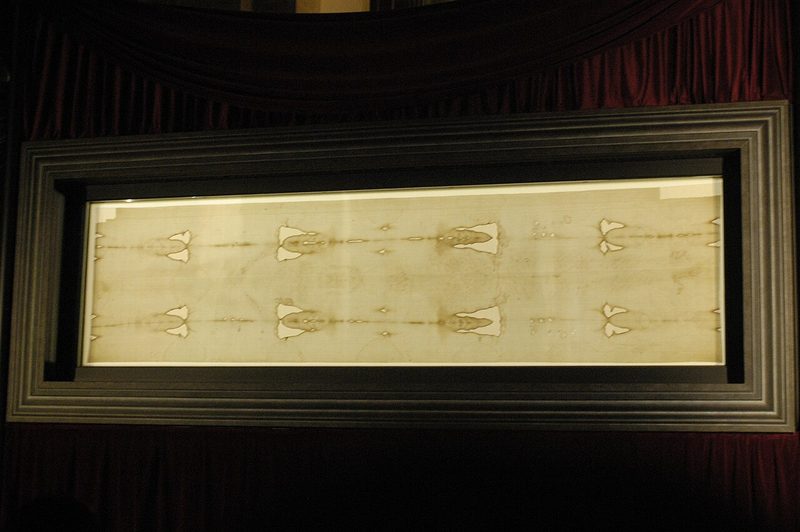
The linen cloth venerated as the Shroud of Turin, on display in Turin Cathedral during the 2010 exposition. Image: Fabio Poggi · CC BY 3.0

1 Shroud of Turin

Kept at
The last chapel of the left nave, under the Royal Tribune — Turin Cathedral (San Giovanni Battista), Turin, Italy · exact location on OpenStreetMap
The object
A linen cloth in herringbone weave, about 4.41 × 1.13 m, bearing the faint front and back image of a man, per the custodian. It lies in a conservation case sealed inside a large metal chest.
When it can be seen
Not visible: "La Sindone non si può vedere", the custodian writes; it is taken out only for public expositions, and "no one knows when the next exposition will be". The chapel with the chest can be visited during cathedral hours.
First attested
Lirey, France, in the 1350s — the collegiate church founded on 20 June 1353 per the Catholic Encyclopedia, "about the year 1360" per another of its articles.
Scientific dating
Radiocarbon: "AD 1260-1390, with at least 95% confidence" (Arizona, Oxford and Zurich, Nature, 1989); the sampling and statistics are contested in later publications.
Acts of Church authorities
None declaring it authentic located. The custodian: the tradition "cannot yet be said to be definitively proven". John Paul II (1998): the Church "has no specific competence to pronounce". Owned by the Holy See since 1983.

[38] [39] [55] [54] [48] [50] [46]

Where the record places it 1353–today

A dot is a dated event that places the object; a solid line joins two in the same place; a hatched stretch means it moved, and the date of the move is not in this record. The last dot is where it is kept today.

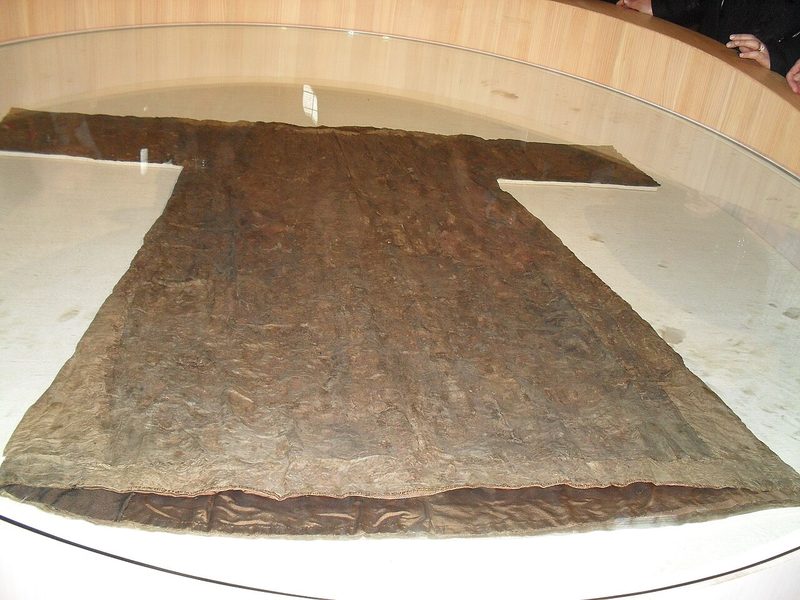
The cloth venerated as the Sudarium of Oviedo
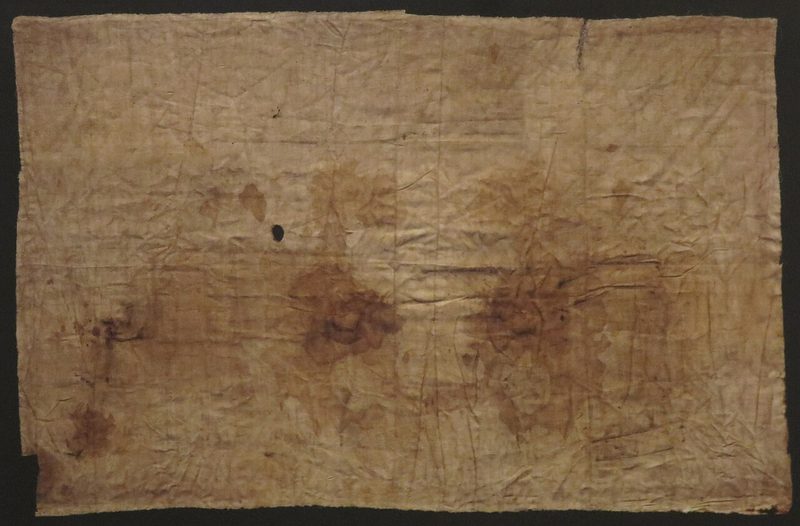
The cloth venerated as the Sudarium of Oviedo, kept in the Cámara Santa of Oviedo Cathedral. Image: Reinhard Dietrich · CC BY-SA 4.0

2 Sudarium of Oviedo

Kept at
The Cámara Santa of Oviedo Cathedral (San Salvador), Oviedo, Spain · exact location on OpenStreetMap
The object
A linen cloth in plain taffeta weave, undyed, 85.5 × 52.6 cm, stained and without an image, mounted on a frame, per the cathedral.
When it can be seen
A facsimile is shown every day. The original, per the cathedral, "can be contemplated three weeks a year": Holy Week, Easter Week and the Jubilee of the Holy Cross, 14–21 September; the faithful are blessed with it on Good Friday and on 14 and 21 September.
First attested
The record of the opening of the Arca Santa on 13 March 1075, which lists "de sudario Domini", per the cathedral.
Scientific dating
Radiocarbon results of the 6th–9th centuries are reported for 1990–1992 and 2007, but no primary publication of them was located.
Acts of Church authorities
None declaring it authentic located; the three yearly blessings are acts of cult.

[57] [58]

Where the record places it 1075–today

  • Oviedo, Spain 1075[57]

A dot is a dated event that places the object; a solid line joins two in the same place; a hatched stretch means it moved, and the date of the move is not in this record. The last dot is where it is kept today.

The Veronica pier of St Peter's Basilica
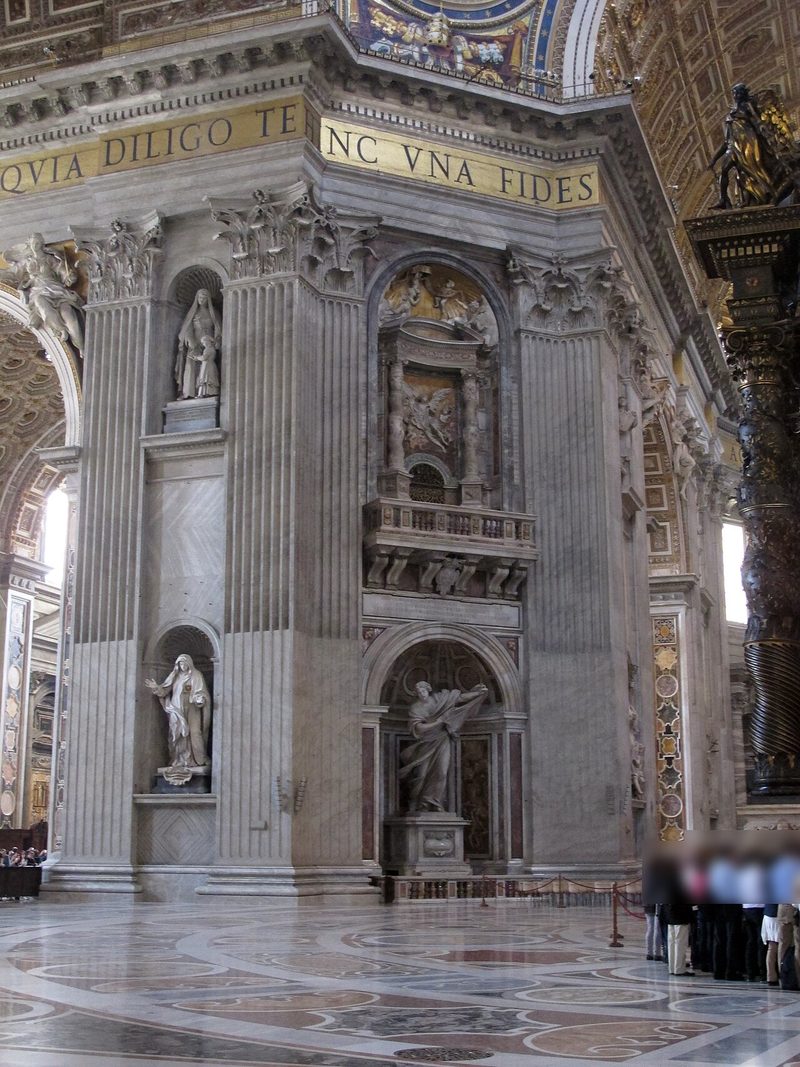
The Veronica pier of St Peter's Basilica, with Francesco Mochi's statue of Saint Veronica (1632) and, above it, the loggia where the relic venerated as Veronica's veil is kept. Image: Sailko · CC BY-SA 3.0

3 Veil of Veronica

Kept at
A chapel inside the Veronica pier of the dome, above the Veronica loggia — St Peter's Basilica, Vatican City · exact location on OpenStreetMap
The object
A veil venerated as bearing the Holy Face; its material, size and case are not described in the sources reached.
When it can be seen
Shown once a year from the Veronica loggia, on the Fifth Sunday of Lent (22 March 2026), per the Fabbrica di San Pietro.
First attested
Sources disagree: Vatican News (2024) dates the first testimonies at St Peter's to the 8th century; other accounts date firm records from 1199.
Scientific dating
None located.
Acts of Church authorities
Exposed as "the Major Relic of the Holy Face" — an act of cult. The Capuchins of Manoppello hold that the original is the image in their shrine, which St Peter's does not concede.

[60] [59] [93] [62]

Where the record places it 2026–today

A dot is a dated event that places the object; a solid line joins two in the same place; a hatched stretch means it moved, and the date of the move is not in this record. The last dot is where it is kept today.

The veil venerated as the Holy Face of Manoppello
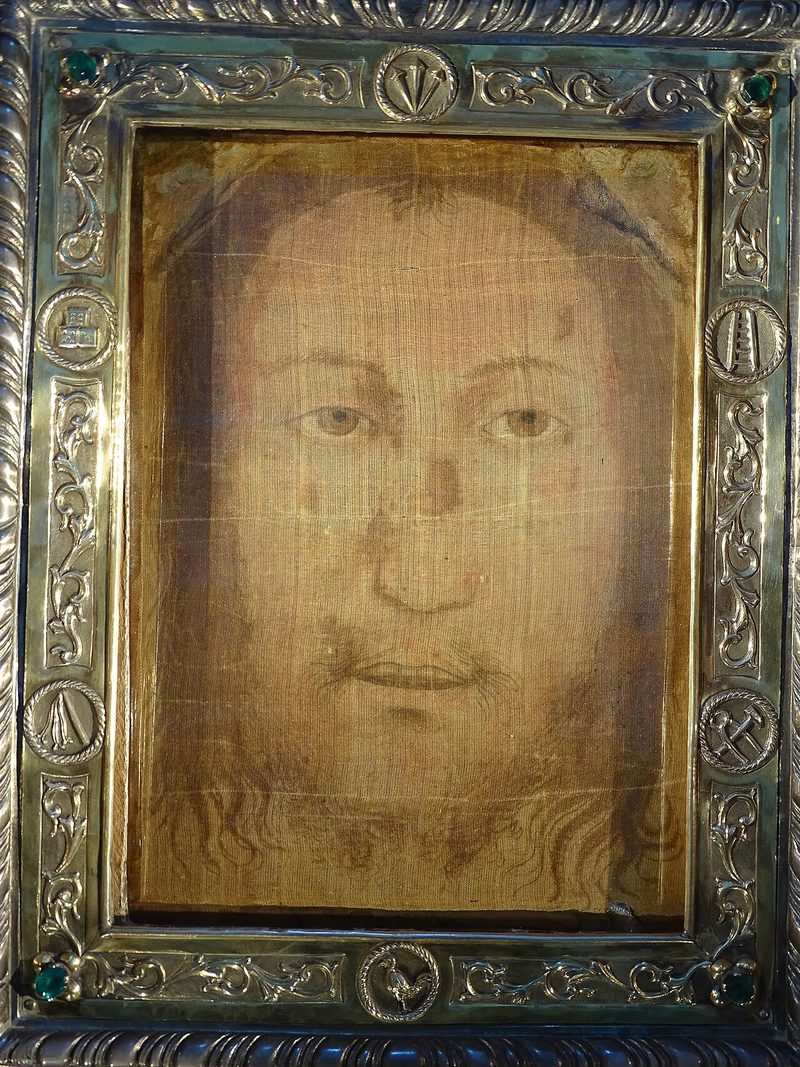
The veil venerated as the Holy Face of Manoppello, in its monstrance-frame in the Basilica of the Volto Santo, photographed in 2019. Image: ElfQrin · CC BY-SA 4.0

4 Volto Santo of Manoppello

Kept at
Basilica-Shrine of the Holy Face (Capuchin friary), Manoppello, Italy · exact location on OpenStreetMap
The object
A thin veil bearing a face, kept in a frame glazed on both sides; its material is disputed (linen or byssus) and no samples have been allowed for testing.
When it can be seen
The basilica is open every day from 6:00 to 19:00, per the shrine.
First attested
The shrine's own account, written in 1640, has a pilgrim bring the veil in about 1506; it has been in the Capuchin church since the 17th century.
Scientific dating
None: no laboratory testing has been allowed.
Acts of Church authorities
None declaring it authentic located. Benedict XVI's visit of 1 September 2006, which he called a private pilgrimage, is an act of cult.

[110] [111] [62] [61]

Where the record places it 2006–today

A dot is a dated event that places the object; a solid line joins two in the same place; a hatched stretch means it moved, and the date of the move is not in this record. The last dot is where it is kept today.

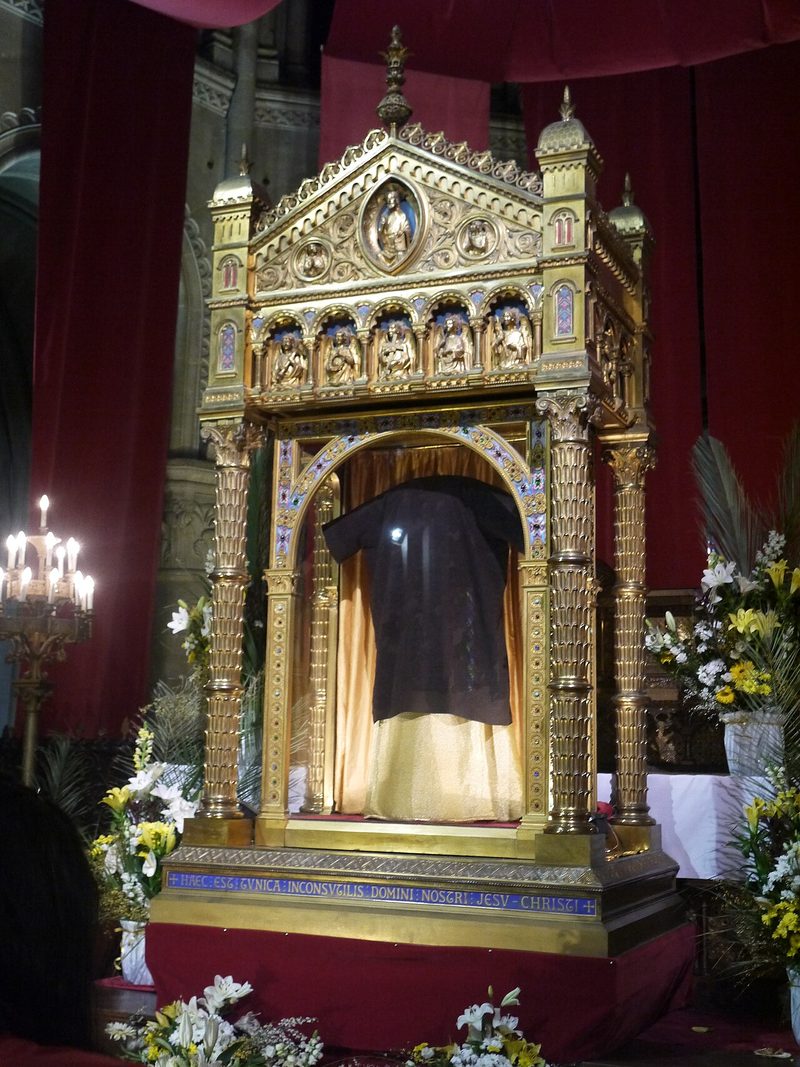
The garment venerated in Trier Cathedral as the Holy Robe (Heiliger Rock)
The garment venerated in Trier Cathedral as the Holy Robe (Heiliger Rock), shown during the 2012 pilgrimage. Image: Ghazwan Mattoka · CC BY-SA 3.0

5 Holy Robe of Trier

Kept at
The Chapel of the Holy Robe, Trier Cathedral (St. Peter), Trier, Germany · exact location on OpenStreetMap
The object
An old woollen core, now partly crumbling felt, held in a 16th-century carrier garment of silk layers, per the diocese; it lies flat in an 1891 wooden shrine under a climate-controlled glass case.
When it can be seen
Not visible: it is kept locked, the cathedral writes, and is shown only at rare pilgrimages (the last from 13 April to 13 May 2012). The chapel opens during the yearly Heilig-Rock-Tage, when the robe itself still cannot be seen.
First attested
The diocese's pages disagree: a first written mention in the 11th century, or the enclosure in the high altar on 1 May 1196.
Scientific dating
None: the core is "not precisely datable", per the diocese; no radiocarbon test was located.
Acts of Church authorities
The cathedral: "The question of the Holy Robe's authenticity cannot be answered with certainty."

[65] [112] [63] [64] [113]

Where the record places it 1196–today

A dot is a dated event that places the object; a solid line joins two in the same place; a hatched stretch means it moved, and the date of the move is not in this record. The last dot is where it is kept today.

The garment venerated as the Holy Tunic of Argenteuil
The garment venerated as the Holy Tunic of Argenteuil, displayed in its reliquary during the 2016 exposition at the Basilica of Saint-Denys, Argenteuil. Image: Simon de l'Ouest · CC BY-SA 4.0

6 Holy Tunic of Argenteuil

Kept at
The chapel and altar-reliquary of the Holy Tunic, Basilica of Saint-Denys, Argenteuil, France · exact location on OpenStreetMap
The object
Pieces of a tunic of sheep's wool dyed with a plant of the madder family, sewn onto a modern wool support and kept in a small reliquary within the altar, per the parish.
When it can be seen
The reliquary can be venerated every day, per the parish; the tunic itself is shown only at solemn expositions, the last from 18 April to 11 May 2025.
First attested
A charter of 1156 recording an exposition before Louis VII, per the parish; its arrival under Charlemagne is the shrine's tradition.
Scientific dating
Radiocarbon: "between the years 530 and 650" (CEA Saclay, 2004), per the parish, which reports the researchers' warning about contamination; a 2005 test giving 670–880 is contested.
Acts of Church authorities
None declaring it authentic located; the expositions under the Bishop of Pontoise are acts of cult. The parish itself argues for authenticity.

[66] [114] [67] [68]

Where the record places it 1156–today

A dot is a dated event that places the object; a solid line joins two in the same place; a hatched stretch means it moved, and the date of the move is not in this record. The last dot is where it is kept today.

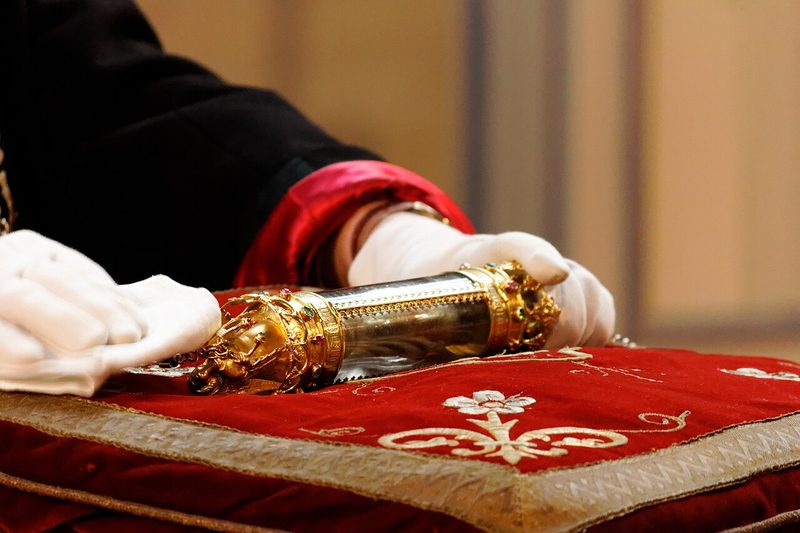
The phial venerated as the Relic of the Holy Blood
The phial venerated as the Relic of the Holy Blood, in its reliquary cylinder at the Basilica of the Holy Blood, Bruges. Image: Ayack · CC BY-SA 3.0

7 Relic of the Holy Blood

Kept at
The upper basilica, Basilica of the Holy Blood, Burg, Bruges, Belgium · exact location on OpenStreetMap
The object
A rock-crystal tube, which the basilica describes as Constantinopolitan work of about 1200. For the procession it is carried in Jan Crabbe's shrine of 1617, some 30 kg of gold and silver.
When it can be seen
Offered for veneration every day from 14:00 to 16:00, and on Fridays from 10:15 to 11:00, per the basilica; carried through the city in the Ascension Day procession.
First attested
The 13th century, per the basilica, which records that the story of an arrival in 1150 is strongly doubted by most historians; the procession is first mentioned in 1291.
Scientific dating
None of the contents located.
Acts of Church authorities
None declaring it authentic located; Clement V's bull of 1310 encouraged pilgrimage, and UNESCO's 2009 listing concerns the procession, not the relic.

[115] [69] [116] [70]

Where the record places it 1291–today

  • Bruges, Belgium 1291[69]

A dot is a dated event that places the object; a solid line joins two in the same place; a hatched stretch means it moved, and the date of the move is not in this record. The last dot is where it is kept today.

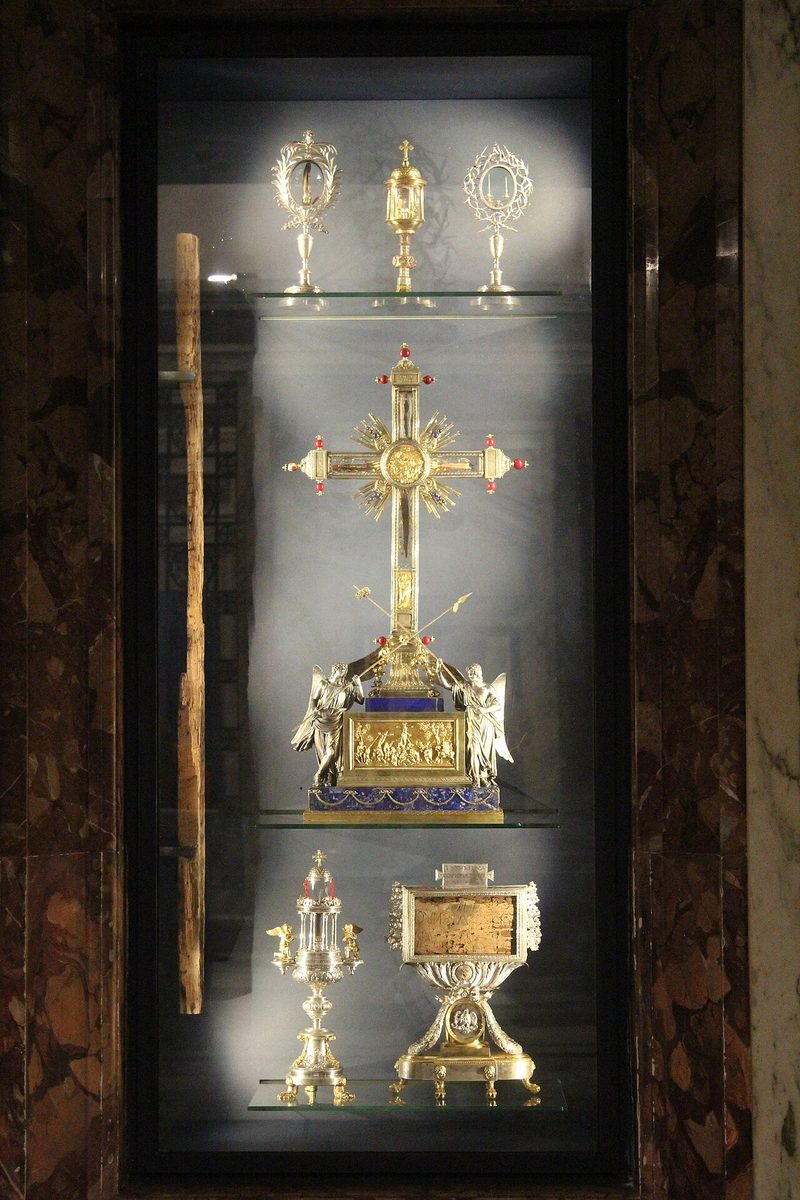
The relic display case in the Chapel of the Relics, Santa Croce in Gerusalemme
The display case in the Chapel of the Relics at Santa Croce in Gerusalemme, Rome, with the reliquaries said to hold fragments of the True Cross and other Passion relics. Image: Fallaner · CC BY-SA 4.0

8 Relics of the True Cross

Kept at
The Chapel of the Relics, Basilica of Santa Croce in Gerusalemme, Rome, Italy · exact location on OpenStreetMap
The object
Fragments of wood in 19th-century reliquaries, kept in a crystal case, per the basilica. Other fragments are venerated at St Peter's, Notre-Dame de Paris, the Holy Sepulchre and Etchmiadzin, among many places.
When it can be seen
Normally on display without booking; the chapel has been closed since 16 April 2026 for urgent works, by order of the Vicariate of Rome and the Ministry of Culture, with no reopening date announced.
First attested
Wood of the Cross is attested in Jerusalem c. 348–350 by Cyril of Jerusalem; the claim that Constantine gave this portion to the basilica rests on the Liber Pontificalis, which the Catholic Encyclopedia treats with reserve.
Scientific dating
None located.
Acts of Church authorities
None declaring any fragment authentic located. The basilica itself writes that Helena "certainly" brought the relics — its own claim.

[82] [117] [71] [81]

Where the record places it 2026–today

  • Rome, Italy 2026[82]

A dot is a dated event that places the object; a solid line joins two in the same place; a hatched stretch means it moved, and the date of the move is not in this record. The last dot is where it is kept today.

The inscribed wooden panel venerated as the Titulus Crucis
The inscribed wooden panel venerated as the Titulus Crucis, in its reliquary at Santa Croce in Gerusalemme, Rome. Image: Fallaner · CC BY-SA 4.0

9 Titulus Crucis

Kept at
The Chapel of the Relics, in the same case as the Cross relics — Basilica of Santa Croce in Gerusalemme, Rome, Italy · exact location on OpenStreetMap
The object
A single piece of walnut wood, about 26 × 14 × 4 cm and 687 g, inscribed in Hebrew, Greek and Latin letters written right to left.
When it can be seen
As for the Cross relics: normally on display; the chapel has been closed since 16 April 2026.
First attested
Found on 1 February 1492 during works in the basilica, per a contemporary diarist; the other contemporary accounts differ on where and how.
Scientific dating
Radiocarbon: AD 980–1146 at two sigma (Roma Tre University, Radiocarbon, 2002); the authors note that this permits the hypothesis that it is a copy.
Acts of Church authorities
None declaring it authentic located; a 1496 bull of Alexander VI cited in some accounts was not located.

[82] [117] [84] [83]

Where the record places it 1492–today

A dot is a dated event that places the object; a solid line joins two in the same place; a hatched stretch means it moved, and the date of the move is not in this record. The last dot is where it is kept today.

The Iron Crown of Lombardy
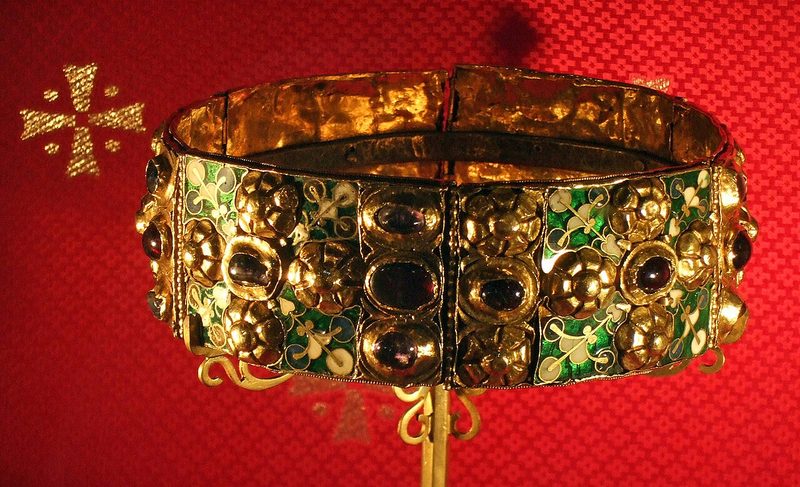
The Iron Crown of Lombardy, a circlet whose inner band is said to be made from a nail of the Crucifixion, in the Theodelinda Chapel of Monza Cathedral. Image: James Steakley · CC BY-SA 3.0

10 Iron Crown of Monza

Kept at
The altar of the Crown in the Chapel of Theodolinda, Monza Cathedral, Monza, Italy · exact location on OpenStreetMap
The object
A small gold diadem, 48 cm round, of six plates set with gems and enamels, around an inner ring venerated as made from a Nail of the Cross. The museum now writes that this ring "is made of silver", adding that it has not been ruled out that it could still be the Nail.
When it can be seen
Seen only on guided 30-minute visits, booked in advance, from Tuesday to Sunday, per the cathedral museum.
First attested
The tradition of a Nail in Helena's diadem goes back to Ambrose (395); the crown's own history at Monza is documented from the 14th century, when Innocent VI confirmed the cathedral's right to host coronations (1354), per the museum.
Scientific dating
Recent studies suggest interventions between the 4th–5th and the 9th centuries, per the museum; the studies are not named.
Acts of Church authorities
Carlo Borromeo "established the cult of the Sacred Nail" in 1576, per the museum — an act of cult; no finding of authenticity located.

[86] [118] [119] [120] [74]

Where the record places it 1576–today

  • Monza, Italy 1576[86]

A dot is a dated event that places the object; a solid line joins two in the same place; a hatched stretch means it moved, and the date of the move is not in this record. The last dot is where it is kept today.

The rush circlet venerated as the Crown of Thorns
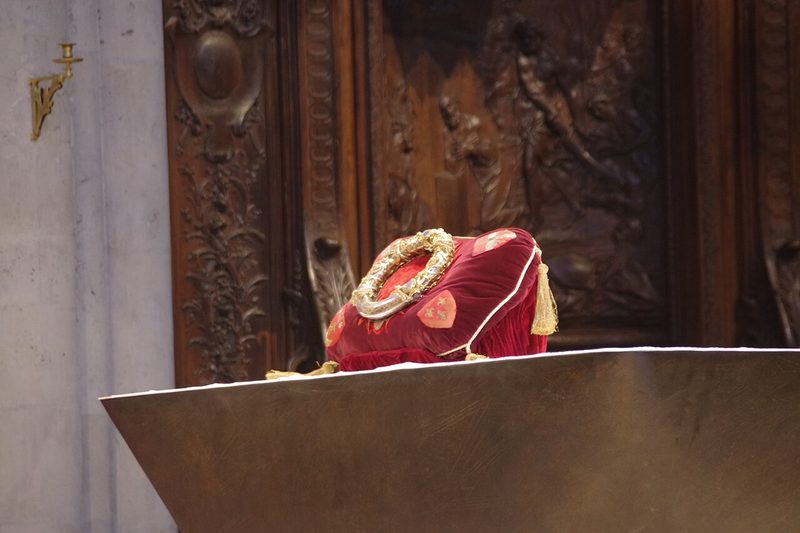
The rush circlet venerated as the Crown of Thorns, in its crystal ring reliquary on a cushion during the veneration service at Notre-Dame de Paris. Image: AlSepPhoenix · CC BY-SA 4.0

11 Crown of Thorns

Kept at
The axial chapel behind the choir, in Sylvain Dubuisson's reliquary — Notre-Dame de Paris, Paris, France · exact location on OpenStreetMap
The object
A ring of bundled rushes, 21 cm across, held with gold thread; its thorns were dispersed over the centuries. It is kept in a 19th-century crystal-and-gold tube, which since December 2024 rests in a new reliquary.
When it can be seen
Shown every Friday from 15:00 to 18:30, venerated in the nave on the first Friday of the month and all day on Good Friday, per the Diocese of Paris.
First attested
A crown was shown on Mount Sion in the 6th century, per two pilgrims' accounts; this object came to Paris with Louis IX on 19 August 1239.
Scientific dating
None located.
Acts of Church authorities
None declaring it authentic located; its expositions and venerations are acts of cult.

[87] [90] [88]

Where the record places it 1239–today

A dot is a dated event that places the object; a solid line joins two in the same place; a hatched stretch means it moved, and the date of the move is not in this record. The last dot is where it is kept today.

The Holy Lance in the Imperial Treasury, Vienna
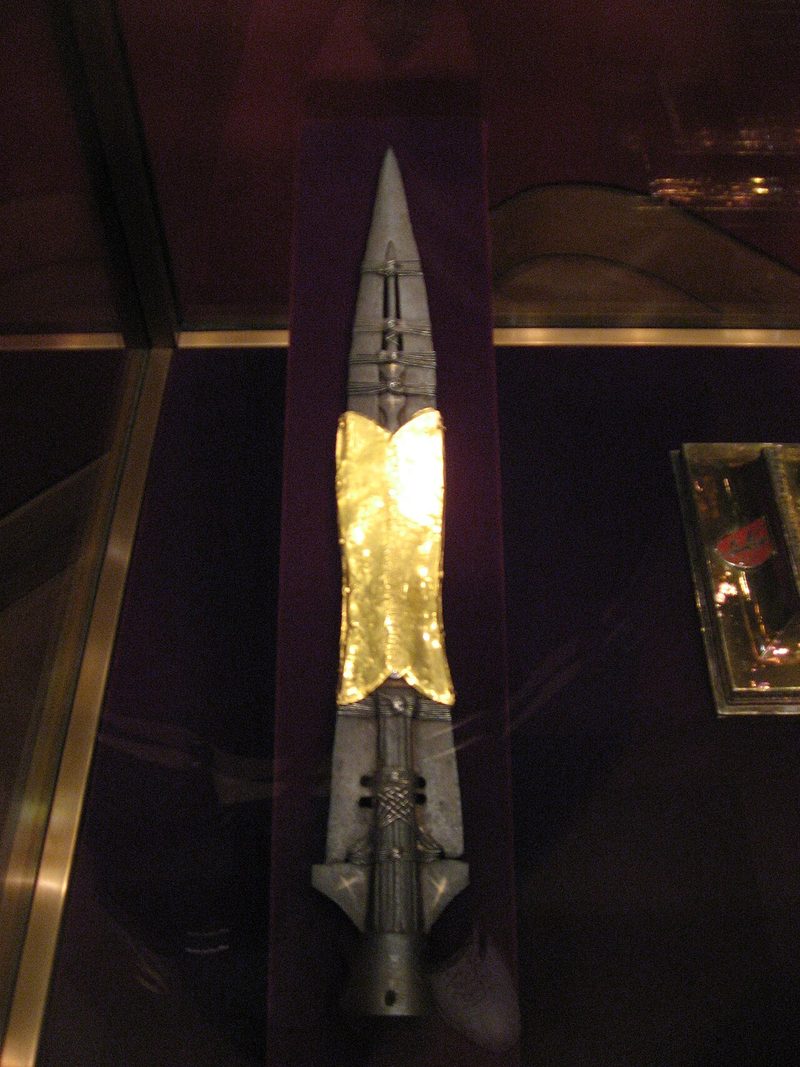
The Holy Lance (Carolingian, 8th century) in the Imperial Treasury (Weltliche Schatzkammer), Vienna. Image: Gryffindor · CC BY-SA 3.0

12 Holy Lance of Vienna

Kept at
The Secular Treasury, Imperial Treasury (Kunsthistorisches Museum), Hofburg, Vienna, Austria · exact location on OpenStreetMap
The object
A Carolingian winged lance of iron and steel, 50.7 cm long, with an iron pin set into the blade and silver and gold sleeves added in the 11th and 14th centuries, the latter inscribed "LANCEA ET CLAVVS DOMINI", per the museum.
When it can be seen
On permanent display; the Treasury is open every day except Tuesday.
First attested
The museum dates the silver sleeve to the second half of the 11th century; an earlier first attestation was not established in the sources reached.
Scientific dating
The blade is 8th-century, per the museum and a University of Vienna study (2003–2004); a 2003 television investigation said the 7th century at the earliest.
Acts of Church authorities
None declaring it authentic. The museum calls its identification with a Nail, and then with Longinus's lance, "pious wishful thinking"; Charles IV obtained a papal feast of the Lance and Nail — an act of cult.

[94] [95] [121] [122]

Where the record places it 2004–today

A dot is a dated event that places the object; a solid line joins two in the same place; a hatched stretch means it moved, and the date of the move is not in this record. The last dot is where it is kept today.

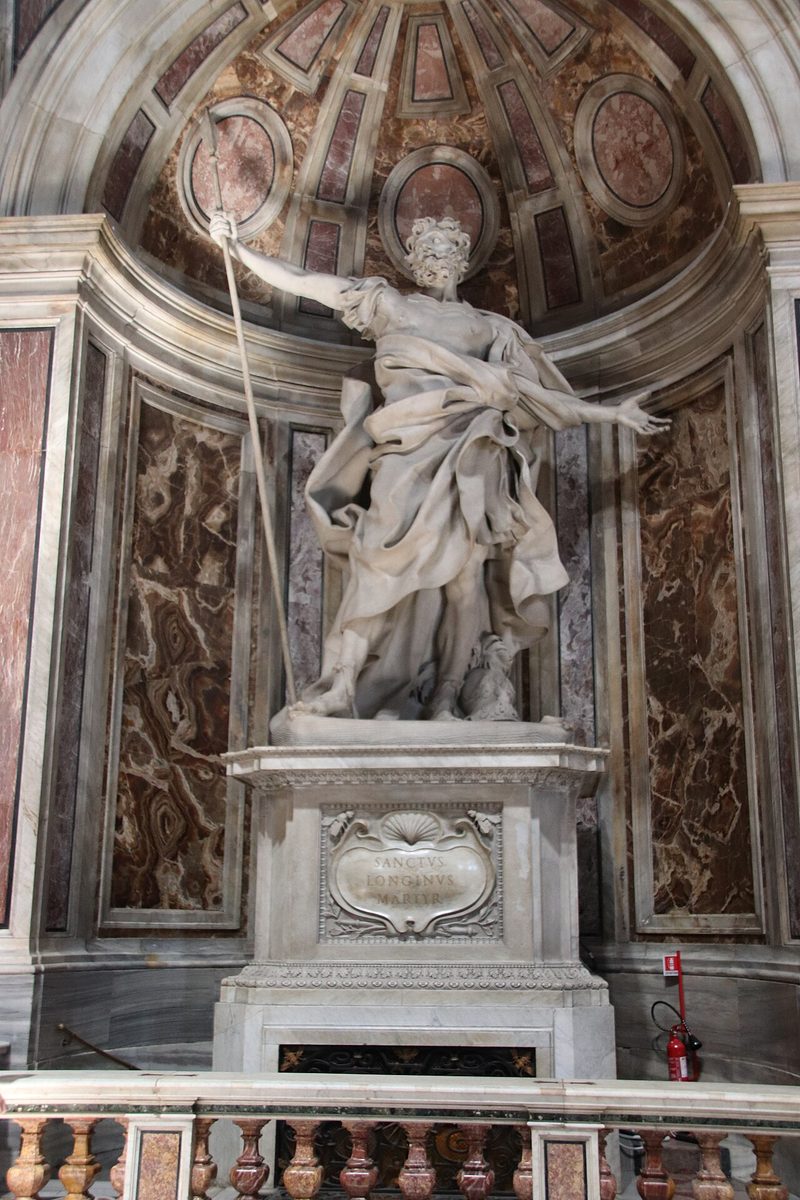
Gian Lorenzo Bernini's statue of Saint Longinus in the Longinus pier of St Peter's Basilica
Gian Lorenzo Bernini's statue of Saint Longinus in the Longinus pier of St Peter's Basilica, whose loggia holds the lance relic kept in the Vatican. Image: Gary Todd · Public domain

13 Holy Lance of St Peter's

Kept at
The Chapel of the Major Relics in the Veronica pier — St Peter's Basilica, Vatican City · exact location on OpenStreetMap
The object
A lance head without its point, per the Catholic Encyclopedia; its material and case are not described in the sources reached.
When it can be seen
Offered for veneration in the second week of Lent, per Vatican News; otherwise not on view.
First attested
Sent by the Ottoman sultan Bayezid II to Pope Innocent VIII in 1492.
Scientific dating
None located.
Acts of Church authorities
None declaring it authentic. The Catholic Encyclopedia records that "great doubts as to its authenticity were felt at Rome" in 1492.

[93] [92]

Where the record places it 1492–today

A dot is a dated event that places the object; a solid line joins two in the same place; a hatched stretch means it moved, and the date of the move is not in this record. The last dot is where it is kept today.

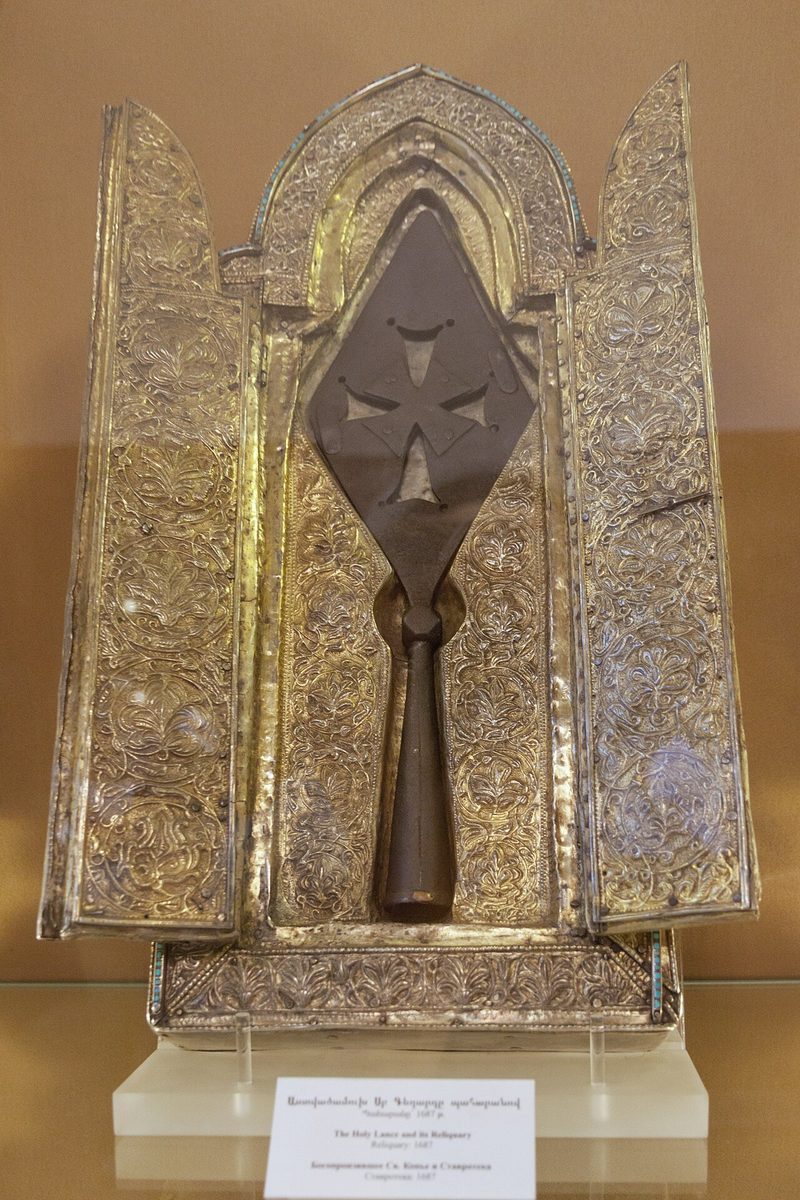
The lance-head venerated as the Holy Lance (Geghard)
The lance-head venerated as the Holy Lance (Geghard), in its reliquary at Etchmiadzin, Armenia, photographed in 2014. Image: Marcin Konsek · CC BY-SA 4.0

14 Holy Lance of Geghard

Kept at
The Alex and Marie Manoogian Treasury-House, Mother See of Holy Etchmiadzin, Vagharshapat, Armenia · exact location on OpenStreetMap
The object
A lance head in a silver reliquary, per the Mother See; a 1908 Catholic source judged it "rather the head of a standard".
When it can be seen
On display in the Treasury-House, where it moved from the cathedral in 2018; open Tuesday to Sunday.
First attested
Not established in the sources reached.
Scientific dating
None located.
Acts of Church authorities
The Armenian Apostolic Church venerates it as "the spear that pierced Christ"; no formal act declaring it authentic was located.

[97] [123] [124] [92]

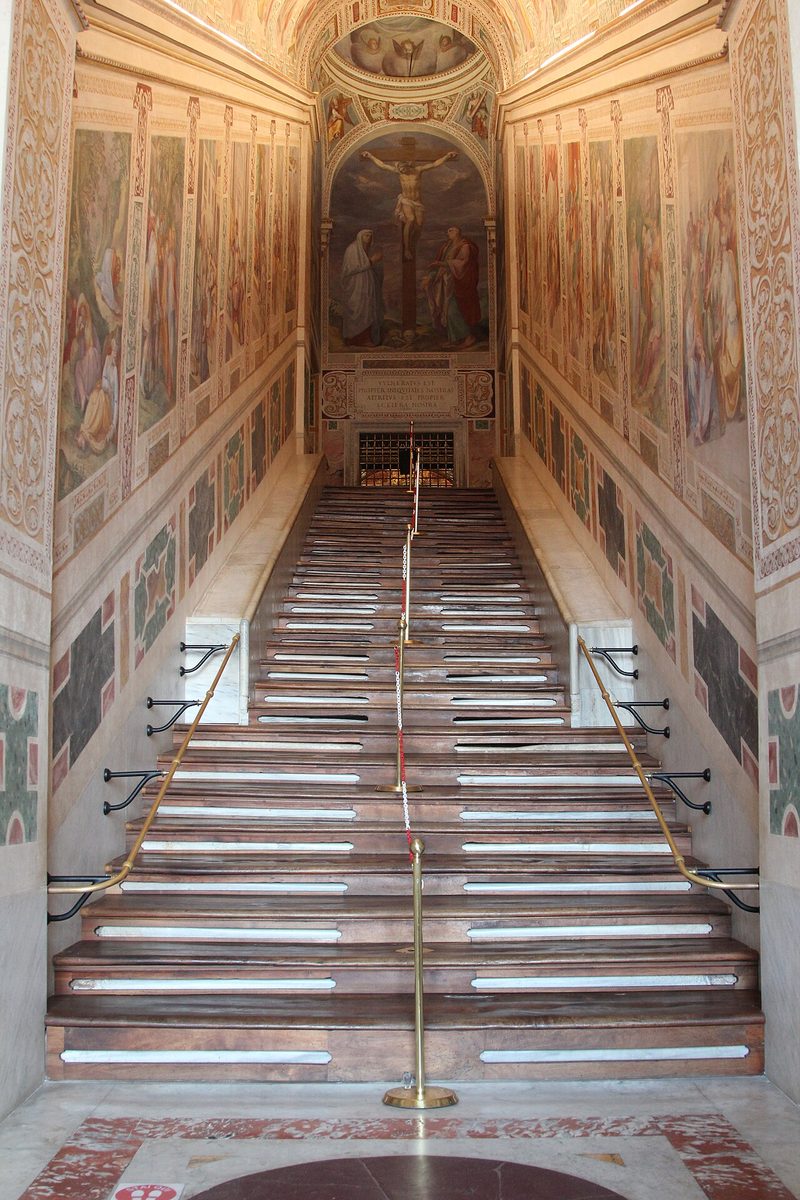
The Scala Sancta in Rome
The Scala Sancta in Rome, the staircase venerated as the one Jesus climbed in Pilate's praetorium, with its protective wooden covering. Image: Fallaner · CC BY-SA 4.0

15 Scala Sancta

Kept at
Pontifical Sanctuary of the Scala Santa and Sancta Sanctorum, Piazza di San Giovanni in Laterano, Rome, Italy · exact location on OpenStreetMap
The object
Twenty-eight marble steps covered in wood since the 1720s, with small windows showing the marble on three of them; the marble was uncovered for sixty days in 2019.
When it can be seen
Open every day and climbed only on the knees, without booking, per the Passionist custodians.
First attested
Not as a dated document: the sanctuary's tradition has Helena bring the steps to Rome in 327–328; Sixtus V moved them to their present site in 1589.
Scientific dating
None located.
Acts of Church authorities
None declaring them authentic; Pius IX's acts of 1853–1854 concern custody, and the indulgences are acts of cult.

[98] [125] [101] [100]

Where the record places it 1589–today

A dot is a dated event that places the object; a solid line joins two in the same place; a hatched stretch means it moved, and the date of the move is not in this record. The last dot is where it is kept today.

The stone column venerated as the Column of the Flagellation
The stone column venerated as the Column of the Flagellation, in its glass case in the Chapel of San Zenone, Santa Prassede, Rome. Image: Rabax63 · CC BY-SA 4.0

16 Column of the Flagellation (Rome)

Kept at
A small chapel off the right aisle, Basilica of Santa Prassede, Rome, Italy · exact location on OpenStreetMap
The object
A short column of black-and-white gabbro-diorite from Egypt's Eastern Desert, 63 cm high, in Duilio Cambellotti's gilded reliquary of 1898, per Vatican News.
When it can be seen
On display in its chapel, per Vatican News (2023).
First attested
By tradition brought from Jerusalem by Cardinal Giovanni Colonna in 1223.
Scientific dating
None located.
Acts of Church authorities
None declaring it authentic; Vatican News writes that its cult "is not tied to any material historical evidence". A rival column is venerated in Jerusalem.

[102]

The column fragment venerated as part of the Column of the Flagellation
The column fragment venerated as part of the Column of the Flagellation, in its niche in the Franciscan Chapel of the Apparition, Church of the Holy Sepulchre, Jerusalem. Image: Fallaner · CC BY-SA 4.0

17 Column of the Flagellation (Jerusalem)

Kept at
The Franciscan Chapel of the Apparition, to the right of the altar — Church of the Holy Sepulchre, Jerusalem · exact location on OpenStreetMap
The object
A piece of a red porphyry column, per the Custody of the Holy Land — a different stone from the column in Rome.
When it can be seen
In the chapel, open with the church every day; venerated in a solemn rite each Holy Wednesday.
First attested
A column was venerated on Mount Sion in the 4th century, per Egeria; the Custody's own pages date its move to the Holy Sepulchre to 1553 or to the 14th century.
Scientific dating
None located.
Acts of Church authorities
None declaring it authentic located.

[77] [103] [73]

The agate cup venerated as the Holy Chalice (Santo Cáliz)
The agate cup venerated as the Holy Chalice (Santo Cáliz), in its showcase in the Chapel of the Holy Chalice, Valencia Cathedral. Image: Vitold Muratov · CC BY-SA 3.0

18 Holy Chalice of Valencia

Kept at
The Chapel of the Holy Chalice (the old chapter house), Valencia Cathedral, Valencia, Spain · exact location on OpenStreetMap
The object
An agate cup that the cathedral dates to the 2nd–1st century BC, on medieval gold handles and a gold foot set with pearls and gems; 17 cm high.
When it can be seen
Seen on the cathedral's cultural visit, and at the Thursday Mass of the Holy Chalice, per the cathedral.
First attested
In 1399 it was delivered by the monastery of San Juan de la Peña to King Martin I; it has been in Valencia Cathedral since 18 March 1437, per the cathedral.
Scientific dating
No laboratory dating located; the cathedral's date is by type.
Acts of Church authorities
None declaring it the cup of the Last Supper located; papal Masses (1982, 2006) and a perpetual jubilee granted in 2015 are acts of cult. The cathedral argues for the tradition.

[126] [127] [128] [129] [105]

The green glass dish known as the Sacro Catino
The green glass dish known as the Sacro Catino, identified in medieval tradition with the dish of the Last Supper, in the Treasury Museum of Genoa Cathedral. Image: Sylvain Billet · CC BY-SA 4.0

19 Sacro Catino

Kept at
The Treasury Museum under Genoa Cathedral (San Lorenzo), Genoa, Italy · exact location on OpenStreetMap
The object
A hexagonal dish of green glass, long believed to be emerald and once called the Holy Grail; broken in the 19th century and reassembled in 1951. It belongs to the City of Genoa.
When it can be seen
On permanent display in the Treasury Museum, Monday to Saturday.
First attested
Brought to Genoa by Guglielmo Embriaco in 1101, per the chronicles.
Scientific dating
Shown in 1806 to be glass, not emerald; described by the city museums as Middle Eastern glassware.
Acts of Church authorities
None: no claim or act located; the object is civic property.

[106] [130]

Where the record places it 1101–today

A dot is a dated event that places the object; a solid line joins two in the same place; a hatched stretch means it moved, and the date of the move is not in this record. The last dot is where it is kept today.

The reliquary of the Sacra Culla
The reliquary of the Sacra Culla, which holds wooden boards venerated as the manger of Jesus, in the confessio of Santa Maria Maggiore, Rome. Image: Jastrow · Public domain

20 Holy Crib

Kept at
The Confessio before the Papal Altar, Basilica of Santa Maria Maggiore, Rome, Italy · exact location on OpenStreetMap
The object
Five slats of sycamore-fig wood in a rock-crystal reliquary designed by Giuseppe Valadier in 1802, per the basilica.
When it can be seen
Not stated in the sources reached.
First attested
The basilica links its title "ad Praesepem" to the 7th century; devotion to the relic is attested from the 13th century, per the Terra Sancta Museum.
Scientific dating
The basilica writes that the slats have been "scientifically" dated to the time of the birth, but cites no study, and none was located.
Acts of Church authorities
None declaring it authentic located; the gift of a fragment to Bethlehem in 2019 is an act of cult.

[108] [131] [107]

Where the record places it 2019–today

A dot is a dated event that places the object; a solid line joins two in the same place; a hatched stretch means it moved, and the date of the move is not in this record. The last dot is where it is kept today.

The icon venerated as the Holy Face of Edessa (Mandylion of Genoa)
The icon venerated as the Holy Face of Edessa (Mandylion of Genoa), in its silver-gilt frame at the Church of San Bartolomeo degli Armeni, Genoa. Image: Postcrosser · CC BY-SA 4.0

21 Mandylion of Genoa

Kept at
Church of San Bartolomeo degli Armeni (Barnabite Fathers), Genoa, Italy · exact location on OpenStreetMap
The object
A face painted in egg tempera on linen, glued to a cedar panel and set in a Byzantine frame of gold and silver filigree, per a local iconographers' group citing radiographic study.
When it can be seen
Exposed once a year for an octave; the timing is given differently in the sources reached.
First attested
Brought from Constantinople by Leonardo Montaldo in 1362 and given to the church in 1384 or 1388.
Scientific dating
None located; a 2004 exhibition studied it as a Byzantine icon.
Acts of Church authorities
None declaring it authentic located; the yearly octave is an act of cult.

[132] [133]

Key figures

Herod the Great

reigned 37–4 BCE · Judea

Roman client king of Judea, "from 37 to 4 B.C." per the bishops' Bible notes; Matthew's birth narrative is set in his reign[3] [20] [11]

Pontius Pilate

prefect 26–36 · Roman Empire

Roman prefect of Judea who sentenced Jesus, per the Gospels, Tacitus and Josephus; the Caesarea inscription gives his title as prefect[2] [21] [12]

Joseph Caiaphas

high priest c. 18–36 · Judea

High priest at the time of Jesus's trial, per the Gospels[22] [2] [31]

John the Baptist

preaching from c. 27–29 · Judea

Preacher of repentance who baptized Jesus, per the Gospels; Josephus records his imprisonment and execution by Herod Antipas[2] [23]

Paul of Tarsus

conversion c. 34–35 · Roman Empire

Apostle; in 1 Corinthians 15 he hands on a formula of the Resurrection that he says he himself received[5] [6] [25]

Flavius Josephus

37 – c. 101 · Judea / Rome

Jewish historian; his Antiquities mention James "the brother of Jesus" and contain the disputed Testimonium[24] [11]

Constantine I

emperor 306–337 · Roman Empire

Roman emperor who ordered the church at the tomb in Jerusalem, per Eusebius[26] [15]

Eusebius of Caesarea

c. 260 – before 341 · Roman Empire

Bishop and historian; his Life of Constantine is the near-contemporary — and panegyrical — account of the Jerusalem and Bethlehem churches[27] [15]

Dionysius Exiguus

d. before 544 · Rome

Monk in Rome whose Easter table introduced the reckoning of years from the Incarnation[19]

Helena

c. 250 – c. 330 · Roman Empire

Mother of Constantine; journeyed to Palestine after 324 and dedicated churches at Bethlehem and on the Mount of Olives, per Eusebius. The finding of the Cross is first credited to her by Ambrose in 395; Eusebius does not connect her with it[74] [75] [53] [15]

Louis IX

1214–1270 · France

King of France; acquired the Crown of Thorns in 1239 and built the Sainte-Chapelle to house it[87]

Heraclius

emperor 610–641 · Byzantine Empire

Byzantine emperor; returned the relic of the Cross to Jerusalem in 629 or 630[76] [77]

Geoffroi de Charny

d. 1356 · France

Knight and lord of Lirey, in whose collegiate church the cloth now in Turin was first shown[55]

Pierre d'Arcis

memorandum c. 1389 · France

Bishop of Troyes; his memorandum of c. 1389 reports an earlier finding that the Lirey cloth was painted[56] [54]

Secondo Pia

1855–1941 · Italy

Lawyer and photographer; took the first photograph of the Shroud in 1898[42]

Peter Bartholomew

d. 1099 (to verify) · France

Provençal pilgrim of the First Crusade who led the Antioch lance "discovery" of 1098[96] [92]

Jean Calvin

treatise of 1543 · France / Geneva

Reformer; his Treatise on Relics (1543) is the classic Protestant critique of the Passion relics[79]

Related organizations

Disambiguation & nuance

This subject is contested terrain twice over: between faith and historical criticism about the life, and between tradition and the laboratory about the relics. These distinctions are the ones readers most often flatten.

The Jesus of history ≠ the Christ of faith

Two registers, both recorded here and neither allowed to settle the other: what historical method reconstructs from the sources — that Jesus was executed under Pilate, attested by the Gospels and Tacitus — and what the Church professes, that he is the Christ, the Son of God, risen. The site writes "the Gospels narrate" and "Christians profess" for the second, and names the historian for the first.[12] [6]

BCE / CE, and the error in Anno Domini

BCE and CE number the years exactly as BC and AD do. Dionysius Exiguus counted from the Incarnation, but by Matthew's account the birth fell before Herod's death in 4 BCE — so, by the era's own numbering, "before Christ". There is no year zero: 1 BCE is followed by 1 CE.[18] [19]

Julian dates

Every ancient date here — 7 April 30, 3 April 33, 13 September 335 — is in the Julian calendar used at the time, not converted to the Gregorian.[29]

Prefect ≠ procurator

The Caesarea inscription gives Pilate's title as praefectus; Tacitus and later writers call him procurator, the title the office bore later. Both appear in the sources quoted here.[35] [12]

Three Herods

Herod the Great, in whose reign Matthew sets the birth, died in 4 BCE; Herod Antipas, tetrarch of Galilee, appears in the ministry and the Passion; Herod Agrippa I appears in Acts. They are different men.[20] [2]

The day of the crucifixion: 14 or 15 Nisan

In the Synoptic Gospels the Last Supper is a Passover meal and Jesus dies the next day; in John he dies on the day of preparation, before the Passover. Both place the death on a Friday. Harmonizations exist and are one view among several.[7] [10] [29]

Shroud ≠ Sudarium

The Shroud of Turin is a full-length linen bearing the double image of a man; the Sudarium of Oviedo is a face cloth with stains and no image. They are different objects in different cities; the claim that they fit together is that of the Spanish sindonologists, not a finding.[39] [58]

Veronica ≠ Manoppello ≠ Mandylion

Three objects, three legends: the Veronica is the veil of the Way of the Cross kept at St Peter's; the Volto Santo of Manoppello is an image its Capuchin shrine identifies with the lost original, which St Peter's does not concede; the Mandylion is the image the Abgar legend ties to Edessa.[62] [60]

Titulus ≠ True Cross

The Titulus is a separate object with a separate history: first recorded in Rome in 1492 and radiocarbon-dated to 980–1146. No dating of the Cross wood was located.[83] [82]

Several Holy Lances

The lances of St Peter's, Vienna, Etchmiadzin and Kraków are separate objects with separate histories; the lance "found" at Antioch in 1098 is identified with more than one of them by different authors.[92] [94]

An act of cult is not a verdict of authenticity

Expositions, feasts, indulgences, jubilees, basilicas and papal visits honour or regulate veneration; they are not rulings that an object is what tradition says. The Holy See's 2017 instruction on relics concerns relics of the Blessed and the Saints. This site records each act about each object as what it is.[109] [46]

A laboratory date is its laboratory's

Radiocarbon and other test results are recorded with their authors and journals, and published critiques as critiques. A date range dates the sample tested, not the tradition attached to the object.[48] [50]

References

133 sources · 130 with an Internet Archive fallback. Sources span the spectrum of perspectives by design; contested claims are attributed to their authors.

  1. Luke, chapter 2 (New American Bible, Revised Edition, with notes) · 🗄 archived 2026-09-16 United States Conference of Catholic Bishops (The Catholic bishops' official English Bible; its notes are critical-scholarly.) · book
  2. Luke, chapter 3 (New American Bible, Revised Edition, with notes) · 🗄 archived 2026-06-18 United States Conference of Catholic Bishops (The Catholic bishops' official English Bible; its notes are critical-scholarly.) · book
  3. Matthew, chapter 2 (New American Bible, Revised Edition, with notes) · 🗄 archived 2026-08-20 United States Conference of Catholic Bishops (The Catholic bishops' official English Bible; its notes are critical-scholarly.) · book
  4. Acts of the Apostles, chapter 1 (New American Bible, Revised Edition) · 🗄 archived 2026-07-20 United States Conference of Catholic Bishops (The Catholic bishops' official English Bible; its notes are critical-scholarly.) · book
  5. Acts of the Apostles, chapter 9 (New American Bible, Revised Edition) · 🗄 archived 2026-04-25 United States Conference of Catholic Bishops (The Catholic bishops' official English Bible; its notes are critical-scholarly.) · book
  6. 1 Corinthians, chapter 15 (New American Bible, Revised Edition) · 🗄 archived 2026-04-10 United States Conference of Catholic Bishops (The Catholic bishops' official English Bible; its notes are critical-scholarly.) · book
  7. Mark, chapter 14 (New American Bible) · 🗄 archived 2025-12-03 Holy See (The Holy See's copy of the New American Bible.) · book
  8. Mark, chapter 15 (New American Bible) · 🗄 archived 2025-02-02 Holy See (The Holy See's copy of the New American Bible.) · book
  9. Mark, chapter 16 (New American Bible) · 🗄 archived 2025-05-04 Holy See (The Holy See's copy of the New American Bible.) · book
  10. John, chapter 19 (New American Bible) · 🗄 archived 2025-09-15 Holy See (The Holy See's copy of the New American Bible.) · book
  11. Flavius Josephus, The Antiquities of the Jews (tr. William Whiston) · 🗄 archived 2026-09-21 Project Gutenberg (The 1737 translation; Whiston's footnotes are his own, written from an 18th-century Christian perspective.) · book
  12. Tacitus, Annals, book XV (Loeb translation) LacusCurtius (University of Chicago) (Public-domain translation of the Roman historian.) · book
  13. Suetonius, Life of Claudius (Loeb translation) LacusCurtius (University of Chicago) (Public-domain translation of the Roman biographer.) · book
  14. Letters of Pliny the Younger (tr. Melmoth, revised Bosanquet) · 🗄 archived 2026-08-29 Project Gutenberg (An 18th-century translation whose letter numbering differs from the standard (letter XCVII is Ep. 10.96).) · book
  15. Eusebius, Life of Constantine, book III · 🗄 archived 2026-09-04 New Advent (Nicene and Post-Nicene Fathers) (A near-contemporary but panegyrical source on Constantine.) · book
  16. Eusebius, Life of Constantine, book IV · 🗄 archived 2026-01-07 New Advent (Nicene and Post-Nicene Fathers) (A near-contemporary but panegyrical source on Constantine.) · book
  17. Chronology of the Life of Jesus Christ (Catholic Encyclopedia, 1910) · 🗄 archived 2026-07-26 Catholic Encyclopedia — New Advent (Catholic reference work (Anthony Maas), written from the faith perspective and harmonizing the Gospels.) · encyclopedia
  18. General Chronology (Catholic Encyclopedia, 1908) · 🗄 archived 2026-09-03 Catholic Encyclopedia — New Advent (Catholic reference work, 1908.) · encyclopedia
  19. Dionysius Exiguus (Catholic Encyclopedia, 1909) · 🗄 archived 2026-05-25 Catholic Encyclopedia — New Advent (Catholic reference work (John Gerard), 1909.) · encyclopedia
  20. Herod (Catholic Encyclopedia, 1910) · 🗄 archived 2026-09-15 Catholic Encyclopedia — New Advent (Catholic reference work, 1910.) · encyclopedia
  21. Pontius Pilate (Catholic Encyclopedia, 1911) · 🗄 archived 2026-09-18 Catholic Encyclopedia — New Advent (Catholic reference work, 1911.) · encyclopedia
  22. Joseph Caiphas (Catholic Encyclopedia, 1908) · 🗄 archived 2026-08-11 Catholic Encyclopedia — New Advent (Catholic reference work, 1908.) · encyclopedia
  23. St. John the Baptist (Catholic Encyclopedia, 1910) · 🗄 archived 2026-09-03 Catholic Encyclopedia — New Advent (Catholic reference work, 1910.) · encyclopedia
  24. Flavius Josephus (Catholic Encyclopedia, 1910) · 🗄 archived 2026-07-22 Catholic Encyclopedia — New Advent (Catholic reference work, 1910; it calls the Testimonium's authenticity unsettled.) · encyclopedia
  25. St. Paul (Catholic Encyclopedia, 1911) · 🗄 archived 2026-08-21 Catholic Encyclopedia — New Advent (Catholic reference work (Ferdinand Prat), 1911.) · encyclopedia
  26. Constantine the Great (Catholic Encyclopedia, 1908) · 🗄 archived 2026-06-28 Catholic Encyclopedia — New Advent (Catholic reference work, 1908.) · encyclopedia
  27. Eusebius of Caesarea (Catholic Encyclopedia, 1909) · 🗄 archived 2026-09-09 Catholic Encyclopedia — New Advent (Catholic reference work, 1909.) · encyclopedia
  28. Holy Sepulchre (Catholic Encyclopedia, 1910) · 🗄 archived 2026-08-23 Catholic Encyclopedia — New Advent (Catholic reference work, 1910.) · encyclopedia
  29. Humphreys and Waddington, "The Jewish Calendar, a Lunar Eclipse and the Date of Christ's Crucifixion", Tyndale Bulletin 43.2 (1992) · 🗄 archived 2026-02-14 Tyndale House, Cambridge (Astronomical and calendrical study published by an evangelical biblical-research institute.) · academic
  30. Humphreys and Waddington, "Dating the Crucifixion", Nature 306 (1983), 743–746 · 🗄 archived 2025-04-18 Nature (Peer-reviewed; read at the level of its abstract.) · academic
  31. Ossuary of the High Priest Caiaphas, 18–36 CE · 🗄 archived 2026-05-19 Center for Online Judaic Studies (Jewish-studies educational site.) · academic
  32. The Cradle of Christianity (exhibition) · 🗄 archived 2026-06-10 The Israel Museum, Jerusalem (The museum that holds the Pilate inscription and the Caiaphas ossuary.) · official
  33. OnSite: Bethlehem's Church of the Nativity · 🗄 archived 2026-04-18 Biblical Archaeology Society (Popular-scholarly archaeology magazine.) · news
  34. Birthplace of Jesus: Church of the Nativity and the Pilgrimage Route, Bethlehem · 🗄 archived 2026-09-20 UNESCO World Heritage Centre · official The World Heritage listing; read through its Wayback Machine snapshot of 20 September 2026, the live page being bot-walled.
  35. Pilate stone · 🗄 archived 2026-09-11 Wikipedia (Tertiary; used only for the discovery details, with the museum page.) · encyclopedia
  36. Church of the Holy Sepulchre · 🗄 archived 2026-09-11 Wikipedia (Tertiary.) · encyclopedia
  37. Dionysius Exiguus' Easter table · 🗄 archived 2026-08-31 Wikipedia (Tertiary.) · encyclopedia
  38. Dov'è la Sindone · 🗄 archived 2026-04-21 Archdiocese of Turin — Diocesan Commission for the Shroud (The custodian's own site: where the cloth is kept, and that the Holy See owns it by Umberto II's bequest.) · official
  39. Cos'è la Sindone · 🗄 archived 2026-04-21 Archdiocese of Turin — Diocesan Commission for the Shroud · official The custodian's description of the cloth; it states that the tradition identifying it with Christ's burial cloth "cannot yet be said to be definitively proven".
  40. Il Custode della Sindone · 🗄 archived 2026-05-21 Archdiocese of Turin — Diocesan Commission for the Shroud (The office of the Pontifical Custodian, held by the Archbishop of Turin.) · official
  41. Ostensione 1578 · 🗄 archived 2026-04-21 Archdiocese of Turin — Diocesan Commission for the Shroud (The custodian's account of the transfer from Chambéry to Turin.) · official
  42. Ostensione 1898 · 🗄 archived 2026-06-10 Archdiocese of Turin — Diocesan Commission for the Shroud (The custodian's account of the 1898 exposition and Secondo Pia's photograph.) · official
  43. Ostensione 1978 · 🗄 archived 2026-03-13 Archdiocese of Turin — Diocesan Commission for the Shroud (The custodian's account of the 1978 exposition and the examinations that followed it.) · official
  44. L'incendio del 1997 · 🗄 archived 2026-04-21 Archdiocese of Turin — Diocesan Commission for the Shroud (The custodian's account of the fire of 11–12 April 1997.) · official
  45. Comunicato del Custode, 4 agosto 2025 · 🗄 archived 2026-06-10 Archdiocese of Turin — Pontifical Custodian of the Shroud (The Custodian's statement on the hypotheses published in 2025.) · official
  46. John Paul II, address in Turin Cathedral (24 May 1998) · 🗄 archived 2026-01-16 Holy See · official Papal address during the 1998 exposition; states that the Church "has no specific competence to pronounce" on the scientific questions.
  47. Benedict XVI, meditation before the Shroud (2 May 2010) · 🗄 archived 2026-06-15 Holy See (Papal meditation during the 2010 exposition — a devotional reading of the cloth as an "Icon".) · official
  48. Damon et al., "Radiocarbon dating of the Shroud of Turin", Nature 337 (1989), 611–615 · 🗄 archived 2026-08-25 Nature (The joint report of the Arizona, Oxford and Zurich laboratories; the publisher's page carries the abstract.) · academic
  49. Radiocarbon dating of the Shroud of Turin — full text · 🗄 archived 2026-09-04 Shroud of Turin Website (Barrie Schwortz) (A reproduction of the Nature paper on a site favourable to authenticity; cited only for the paper's own words.) · academic
  50. Casabianca et al., "Radiocarbon Dating of the Turin Shroud: New Evidence from Raw Data", Archaeometry 61 (2019) · 🗄 archived 2026-02-26 Wiley — Archaeometry · academic A published statistical critique of the 1988 dating, read through its Crossref abstract; the publisher's page is bot-walled.
  51. A Summary of STURP's Conclusions (1981) · 🗄 archived 2026-08-16 Shroud of Turin Website (Barrie Schwortz) · report The Shroud of Turin Research Project's own summary of its 1978 examination, on a site favourable to authenticity.
  52. McCrone, "The Shroud of Turin: blood or artist's pigment?", Accounts of Chemical Research 23 (1990), 77–83 · 🗄 archived 2023-01-23 American Chemical Society — Accounts of Chemical Research · academic The microscopist's case that the image is iron-oxide and vermilion paint, disputing STURP; read at the level of its published record.
  53. St. Helena (Catholic Encyclopedia, 1910) · 🗄 archived 2026-07-19 Catholic Encyclopedia — New Advent (Catholic reference work (Kirsch).) · encyclopedia
  54. The Holy Shroud (Catholic Encyclopedia, 1912) · 🗄 archived 2026-04-14 Catholic Encyclopedia — New Advent (Catholic reference work (Herbert Thurston); sceptical of the Lirey cloth's authenticity.) · encyclopedia
  55. Troyes (Catholic Encyclopedia, 1912) · 🗄 archived 2026-06-17 Catholic Encyclopedia — New Advent · encyclopedia Catholic reference work; its account of the 1390 bulls differs from the same encyclopedia's "Holy Shroud" article.
  56. The memorandum of Pierre d'Arcis (Thurston's 1903 translation) · 🗄 archived 2025-12-18 priory-of-sion.com · archive Herbert Thurston's translation from The Month (1903), hosted on a partisan esoteric site; cited only for the translated text.
  57. Cámara Santa · 🗄 archived 2026-08-16 Catedral de San Salvador de Oviedo (The custodian cathedral's own account of the Arca Santa and its relics.) · official
  58. El Santo Sudario: investigaciones y estudios · 🗄 archived 2024-06-02 Centro Español de Sindonología (An association that argues for authenticity; cited for its own research programme.) · web
  59. Rite of the Holy Face, St Peter's Basilica (press release, 2025) · 🗄 archived 2026-01-20 Holy See Press Office (Announcement of the annual exposition of the Veil from the Veronica loggia.) · official
  60. St Peter's Basilica: the Rite of the Holy Face on 22 March · 🗄 archived 2026-05-17 Fabbrica di San Pietro (The basilica's announcement of the 2026 exposition.) · official
  61. Benedict XVI at the Shrine of the Holy Face, Manoppello (1 September 2006) · 🗄 archived 2026-01-20 Holy See (Papal address on a visit the text itself calls a private pilgrimage.) · official
  62. E a Roma la Veronica? · 🗄 archived 2026-05-17 Santuario del Volto Santo, Manoppello (Capuchin Friars) (The Manoppello shrine's argument that the Roman Veronica was lost — an interested party.) · official
  63. Der Heilige Rock — häufige Fragen · 🗄 archived 2023-05-28 Bistum Trier (The custodian diocese's own answers, including on authenticity.) · official
  64. Geschichte der Tunika · 🗄 archived 2025-12-08 Bistum Trier (The custodian diocese's history of the relic; it calls the Helena story a legend.) · official
  65. Der Heilige Rock — Wallfahrten · 🗄 archived 2026-06-16 Hohe Domkirche Trier · official The cathedral's list of pilgrimages and its statement that the authenticity question "cannot be answered with certainty".
  66. La Tunique · 🗄 archived 2026-04-15 Paroisse d'Argenteuil — Diocèse de Pontoise (The custodian parish's history of the tunic, including the dating it reports; it argues for authenticity.) · official
  67. La Sainte Tunique d'Argenteuil · 🗄 archived 2026-06-30 Paroisse d'Argenteuil — Diocèse de Pontoise (The custodian parish's site, including the 2025 exposition.) · official
  68. Tunique d'Argenteuil · 🗄 archived 2026-02-12 Wikipédia (Tertiary; used only for the contested 2005 test, which no primary source reached.) · encyclopedia
  69. De relikwie van het Heilig Bloed en de Heilig Bloedprocessie · 🗄 archived 2026-06-15 Basilica of the Holy Blood, Bruges (The custodian basilica's own history; it records that historians strongly doubt the traditional 1150 arrival.) · official
  70. Procession of the Holy Blood in Bruges · 🗄 archived 2026-03-15 UNESCO (The 2009 inscription of the procession — not of the relic — on the intangible-heritage list.) · official
  71. Cyril of Jerusalem, Catechetical Lecture 4 · 🗄 archived 2026-07-24 New Advent (Nicene and Post-Nicene Fathers) (Primary text, c. 348–350, in the 19th-century English translation.) · book
  72. Cyril of Jerusalem, Catechetical Lecture 10 · 🗄 archived 2026-07-13 New Advent (Nicene and Post-Nicene Fathers) (Primary text, c. 348–350, in the 19th-century English translation.) · book
  73. The Pilgrimage of Etheria (McClure and Feltoe, 1919) · 🗄 archived 2026-09-05 Christian Classics Ethereal Library (A pilgrim's account of Jerusalem, c. 381–384, with the editors' notes.) · book
  74. Ambrose, De obitu Theodosii (Latin text) · 🗄 archived 2025-09-26 Wikisource (Latin) (Primary text of the funeral oration of 395, from the Migne edition.) · book
  75. Ambrose of Milan, Oration on the Death of Theodosius 48 · 🗄 archived 2025-05-18 Judaism and Rome (Academic commentary: dates the oration and notes that Eusebius does not connect Helena with the Cross.) · academic
  76. Jerusalem (A.D. 71–1099) (Catholic Encyclopedia, 1910) · 🗄 archived 2026-08-24 Catholic Encyclopedia — New Advent (Catholic reference work, 1910.) · encyclopedia
  77. Basilica of the Holy Sepulchre · 🗄 archived 2026-08-25 Custody of the Holy Land (Franciscans) (The Latin custodian's own page on the basilica and the relics it keeps; devotional.) · official
  78. The Battle of Hattin (1187): Four Accounts · 🗄 archived 2026-02-09 De Re Militari (Society for Medieval Military History) (Translated primary sources on the battle.) · corpus
  79. Jean Calvin, Traité des reliques (1543) · 🗄 archived 2026-09-17 info-bible.org (Protestant polemical primary text, hosted by a Protestant site — the critical case against the relics.) · book
  80. Rohault de Fleury, Mémoire sur les instruments de la Passion (1870) Internet Archive (L. Lesort, Paris, 1870) (A Catholic antiquarian's survey written against Calvin's estimate.) · book
  81. The True Cross (Catholic Encyclopedia, 1908) · 🗄 archived 2026-08-04 Catholic Encyclopedia — New Advent (Catholic reference work (Fernand Cabrol).) · encyclopedia
  82. La Cappella delle Reliquie · 🗄 archived 2026-03-08 Basilica di Santa Croce in Gerusalemme (The custodian basilica's own page, carrying its April 2026 closure notice.) · official
  83. Bella and Azzi, "14C Dating of the 'Titulus Crucis'", Radiocarbon 44 (2002), 685–689 · 🗄 archived 2026-04-14 Radiocarbon (Cambridge University Press) (The laboratory report of the Titulus dating, Roma Tre University.) · academic
  84. Fake news in fifteenth-century Rome: the miraculous discovery of the Titulus Crucis relic · 🗄 archived 2024-12-06 Leiden Medievalists Blog (A medievalist's reading of the 1492 accounts; its interpretation of the timing is the author's.) · analysis
  85. Holy Nails (Catholic Encyclopedia, 1911) · 🗄 archived 2026-08-30 Catholic Encyclopedia — New Advent (Catholic reference work (Herbert Thurston); sceptical of most of the nails venerated.) · encyclopedia
  86. The Iron Crown · 🗄 archived 2026-07-28 Museo e Tesoro del Duomo di Monza (The custodian museum's account, including the dating it reports.) · official
  87. La Sainte Couronne d'épines de Notre-Dame de Paris · 🗄 archived 2026-09-27 Diocèse de Paris (The custodian diocese's history of the Crown and its current veneration.) · official
  88. Crown of Thorns (Catholic Encyclopedia, 1908) · 🗄 archived 2026-07-27 Catholic Encyclopedia — New Advent (Catholic reference work (Herbert Thurston).) · encyclopedia
  89. 26 avril 1248: consécration de la Sainte-Chapelle · 🗄 archived 2026-09-14 Herodote.net (Popular history.) · web
  90. Une nouvelle châsse-reliquaire à Notre-Dame · 🗄 archived 2025-10-18 Le Journal des Arts (Independent art press.) · news
  91. L'aumônier des sapeurs-pompiers raconte comment il a sauvé la couronne d'épines · 🗄 archived 2025-06-10 Europe 1 (Radio news; the chaplain's role rests on his own account.) · news
  92. The Holy Lance (Catholic Encyclopedia, 1910) · 🗄 archived 2026-07-26 Catholic Encyclopedia — New Advent (Catholic reference work (Herbert Thurston); records the doubts raised in Rome in 1492.) · encyclopedia
  93. Tracce di Vangelo nella Basilica Vaticana · 🗄 archived 2026-07-16 Vatican News (The Holy See's news portal on the major relics of St Peter's.) · news
  94. Die Heilige Lanze · 🗄 archived 2026-03-07 Kunsthistorisches Museum Wien (The custodian state museum's object record and dating.) · official
  95. Die hl. Lanze des Kunsthistorischen Museums, Wien · 🗄 archived 2024-07-24 VIAS — University of Vienna (The archaeometallurgical study of 2003–2004.) · academic
  96. The Siege and Capture of Antioch (Gesta; Raymond d'Aguiliers) · 🗄 archived 2026-05-24 Fordham Internet Medieval Sourcebook (Translated crusade chronicles.) · corpus
  97. Alex and Marie Manoogian Treasury-House · 🗄 archived 2025-12-06 Mother See of Holy Etchmiadzin (The custodian (Armenian Apostolic Church) listing its relics.) · official
  98. La Scala Santa · 🗄 archived 2025-12-03 Pontificio Santuario della Scala Santa (Passionists) (The custodian sanctuary's account of the tradition.) · official
  99. Chi siamo · 🗄 archived 2026-05-17 Pontificio Santuario della Scala Santa (Passionists) (The custodians' account of Pius IX's acts of 1853–1854.) · official
  100. Scala Sancta (Catholic Encyclopedia, 1912) · 🗄 archived 2026-07-14 Catholic Encyclopedia — New Advent (Catholic reference work; attributes the Helena tradition to "the historians of the monument".) · encyclopedia
  101. Scala Santa, apertura straordinaria (2019) · 🗄 archived 2026-02-08 Musei Vaticani (The Vatican Museums' notice of the restored marble steps.) · official
  102. Il mistero della colonna della flagellazione di Santa Prassede · 🗄 archived 2023-07-20 Vatican News (The Holy See's news portal; it notes that the column's name and its donor's surname coincide.) · news
  103. Holy Wednesday in Jerusalem: the veneration of the Column · 🗄 archived 2026-02-11 Custody of the Holy Land (Franciscans) (The custodian's news page; its date for the column's arrival differs from the sanctuary page.) · official
  104. The Holy Chalice · 🗄 archived 2026-01-23 Catedral de Valencia (The custodian cathedral's own account; it reports the tradition as tradition.) · official
  105. Jubilee of the Holy Chalice · 🗄 archived 2026-01-23 Catedral de Valencia (The cathedral's account of the perpetual jubilee granted in 2015.) · official
  106. Il Sacro Catino · 🗄 archived 2024-06-10 ArtBonus — Italian Ministry of Culture (State heritage page on the Genoa dish, including the 1806 finding that it is glass.) · official
  107. Reliquia della culla di Gesù Bambino alla Custodia di Terra Santa · 🗄 archived 2025-07-24 Vatican News (The Holy See's news portal on the 2019 gift of a fragment to Bethlehem.) · news
  108. Sacra Culla · 🗄 archived 2026-01-06 Basilica di Santa Maria Maggiore (The custodian basilica's page; it claims a scientific dating without citing the study.) · official
  109. Instruction "Relics in the Church: Authenticity and Preservation" (2017) · 🗄 archived 2026-09-12 Congregation for the Causes of Saints (The Holy See's current norms on relics — which concern relics of the Blessed and the Saints.) · official
  110. Storia del Volto Santo · 🗄 archived 2026-05-17 Santuario del Volto Santo, Manoppello · official The Capuchin custodians' history of the image, including the 1640 account of its arrival — the shrine's own tradition.
  111. Orario di apertura · 🗄 archived 2026-05-17 Santuario del Volto Santo, Manoppello (The shrine's opening hours.) · official
  112. Der Heilige Rock · 🗄 archived 2026-09-01 Hohe Domkirche Trier (The cathedral's page on the robe and its chapel.) · official
  113. Heilig-Rock-Tage · 🗄 archived 2025-11-08 Bistum Trier (The diocese's annual days, when the robe's chapel opens.) · official
  114. Foire aux questions · 🗄 archived 2025-04-20 Paroisse d'Argenteuil — Diocèse de Pontoise (The custodian parish's answers on the altar-reliquary and on daily veneration.) · official
  115. Welkom — Heilig-Bloedbasiliek · 🗄 archived 2026-07-21 Basilica of the Holy Blood, Bruges (The custodian basilica's address and veneration hours.) · official
  116. Museum van het Heilig Bloed · 🗄 archived 2026-04-16 Basilica of the Holy Blood, Bruges (The basilica's museum, including Jan Crabbe's 1617 procession shrine.) · official
  117. Basilica di Santa Croce in Gerusalemme · 🗄 archived 2026-07-31 Basilica di Santa Croce in Gerusalemme (The basilica's home page, carrying its notice that the relic chapel is closed.) · official
  118. The Iron Crown as a work of art · 🗄 archived 2026-07-28 Museo e Tesoro del Duomo di Monza · official The custodian museum's description of the crown, including its statement that the inner ring is made of silver.
  119. Opening hours · 🗄 archived 2026-09-27 Museo e Tesoro del Duomo di Monza (The museum's visiting hours and booking rules for the Crown.) · official
  120. The cult of the Sacred Nail · 🗄 archived 2025-08-08 Museo e Tesoro del Duomo di Monza (The museum's account of the cult and the September procession.) · official
  121. Öffnungszeiten und Eintrittspreise · 🗄 archived 2026-09-06 Kaiserliche Schatzkammer Wien (The Imperial Treasury's opening hours.) · official
  122. Piercing an Ancient Tale (8 June 2003) · 🗄 archived 2025-05-31 Time (A magazine report of a television documentary's test of the Vienna lance; not peer-reviewed.) · news
  123. Museums at the Mother See · 🗄 archived 2026-09-15 Mother See of Holy Etchmiadzin (The custodian's museums page: hours and access.) · official
  124. Holy Lance shown to the press (Shoghakat TV, 6 July 2018) · 🗄 archived 2026-09-27 Shoghakat TV (The Armenian Church's television channel.) · news
  125. Informazioni · 🗄 archived 2026-06-08 Pontificio Santuario della Scala Santa (The custodians' visiting rules and hours.) · official
  126. About the Holy Chalice · 🗄 archived 2026-01-23 Catedral de Valencia (The custodian cathedral's description, including its own dating and its case for the tradition.) · official
  127. Chronology of the Holy Chalice · 🗄 archived 2026-01-23 Catedral de Valencia (The cathedral's chronology of the chalice's documented custody.) · official
  128. The Chapel of the Holy Chalice · 🗄 archived 2026-10-04 Catedral de Valencia (The cathedral's page on the chapel.) · official
  129. Hours and admission · 🗄 archived 2026-01-23 Catedral de Valencia (The cathedral's visiting hours.) · official
  130. Museo del Tesoro della Cattedrale di San Lorenzo · 🗄 archived 2026-05-20 Musei di Genova — Comune di Genova (The city museums' page on the cathedral treasury.) · official
  131. A relic of the Holy Cradle returns to the Holy Land · 🗄 archived 2025-12-28 Terra Sancta Museum (The Custody of the Holy Land's museum.) · official
  132. Il Mandylion di Genova · 🗄 archived 2026-05-15 Iconografi di Genova (A local iconographers' group, drawing on the Barnabite Fathers' material; devotional.) · web
  133. Mandylion: intorno al Sacro Volto (exhibition, Genoa, 2004) · 🗄 archived 2026-06-09 Archivio Volto Santo (Record of the 2004 exhibition and catalogue that studied the Genoa image as a Byzantine icon.) · archive